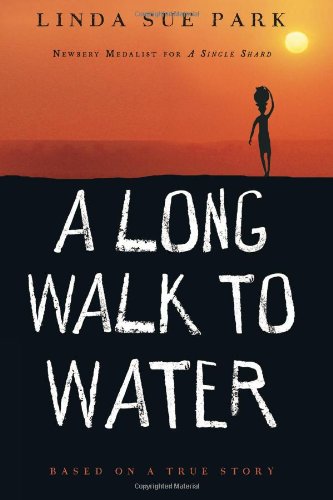
Two footsteps, two timelines, one small, stubborn need: water. In walking Between Two Stories — a review of A Long Walk to Water by Linda Sue Park — the reader is invited to tread a narrow path that connects a boy forced to flee war and a girl who walks daily for the life-sustaining liquid her family lacks. Park’s spare prose and interlaced chapters move like measured steps across seasons and decades, drawing attention to survival, memory, and the quiet work of hope without drama for drama’s sake.
This review will map how those two narratives are held together: the novel’s structure and pacing, its portrayal of past and environmental realities, and the emotional distance it keeps from its subjects. Rather than argue for an unqualified verdict, I’ll consider for whom the book is written, where it gains power, and where its choices leave questions—so readers can decide whether this is a journey they want to join.
Walking Between Two Stories offering a close reading of the dual narrative and how parallel journeys build historical context and emotional depth
Park threads two lives into a single loom, and the result is a fabric that reveals more than either strand alone. The narrative alternates with quiet precision between a boy fleeing war and a girl fetching water, and in their contrast we find history made intimate: Salva’s marches map the collapse and migration of a nation, while Nya’s daily treks compress the slow, grinding demands of survival. each shift in voice reframes the reader’s gaze — a scene of distance becomes immediate when mirrored against small, domestic detail; a moment of personal courage echoes as a gesture of collective endurance. The dual outlook refuses a single truth and rather accumulates evidence: gestures,landscapes,and lapses that,together,sketch a fuller,more human history.
Best-Selling Books in This Category


The parallel journeys function like a contrapuntal score, where repetition and variation build emotional resonance: the repetition of walking becomes both literal and symbolic, and the variations — age, purpose, danger — tune our empathy. Consider how Park uses pacing and sensory detail to bind the timelines: a dusty horizon described for Salva returns as the same sun-baked earth under Nya’s feet, and that echo transforms setting into testimony. Key techniques that deepen meaning include:
- Juxtaposition — alternating scenes highlight cause and consequence across time.
- Pacing — short, urgent passages for flight versus measured, cyclical descriptions for daily life.
- Concrete detail — small objects and actions anchor broad historical shifts.
| Aspect | Salva / Nya |
|---|---|
| Journey type | forced migration / Daily survival |
| Temporal anchor | War and displacement / Ongoing scarcity |
| Emotional core | Resilience and leadership / Endurance and hope |
Water as both lifeline and metaphor examining how scarcity survival and memory drive character choices and invite classroom discussion topics

Water in Linda Sue Park’s dual narrative functions as both the literal lifeline that propels daily decisions and the quiet metaphor that shapes the characters’ inner landscapes. For Nya, water is a rhythm—an all-day chore that dictates where she goes, who she meets, and how her family survives. For Salva, it becomes a destination and a promise, a scarce commodity that turns strangers into allies and strangers into threats. In both arcs, scarcity forces choices: to leave or to stay, to trust or to hide, to remember or to forget. The physical acts of searching, carrying, and finding water mirror the emotional labor of holding onto memory and hope, so that a single well can signify both survival and reconciliation across time.
This tension between survival needs and the stories we keep opens rich pathways for classroom conversation. discussion starters:
- How does scarcity change a character’s priorities and sense of self?
- In what ways does memory act like water—refreshing,corrosive,or sustaining?
- Which choices feel driven by necessity,and which by hope or loyalty?
- How can a shared resource become a site of conflict and of community?
| Element | Character Response |
|---|---|
| Scarcity | Risk-taking,migration,alliances |
| Survival | Resourcefulness,sacrifice |
| Memory | Motivation to rebuild,preserve identity |
These prompts and the compact table can help students trace how water—both as supply and symbol—steers decisions,reveals values,and invites empathy across two converging stories.
Voice and perspective in short interwoven chapters analyzing tone shifts authenticity of young narrators and readability for middle grade readers

Park’s alternating chapters feel like two speakers passing a single lantern back and forth: each section is short, sharply lit, and tuned to a slightly different frequency. The result is a palpable shift in tone—from the slow, daily grind of fetching water to the sudden panic of fleeing in the night—without ever straining for melodrama.These shifts are achieved through small, deliberate techniques:
- sentence length shortens in urgency;
Together they create a rhythm that is easy for middle grade readers to follow while still honoring the complexity of the characters’ experiences.
The two young narrators feel authentic because Park trusts their perspectives: she gives them specific tasks, concrete fears, and moments of childlike resilience rather than adult explanations. That restraint makes the book highly readable for its intended audience—readers can infer backstory, recognize moral choices, and connect emotionally without being instructed how to feel. Below is a speedy snapshot of how specific elements affect younger readers:
| Element | Effect on Young Reader |
|---|---|
| Short chapters | Encourage momentum and manageable reading chunks |
| Concrete details | Builds empathy through familiar sights and tasks |
| Balanced hope and hardship | Maintains engagement without overwhelming |
This balance—clear voice, believable perspective, and careful pacing—lets middle grade readers walk between two stories without losing their footing.
Historical accuracy and cultural sensitivity evaluating research portrayal of Sudanese conflict and recommendations for supplementary resources and context
Park’s compact storytelling renders complex events into intimate moments, which is both the novel’s strength and its limitation. The book captures emotional realities of displacement and scarcity, yet it compresses timelines and streamlines political and ethnic details for younger readers; the result is resonant but not exhaustive. Readers should treat the narrative as an entry point rather than a definitive account,and actively seek Sudanese voices and historical context to avoid unintended simplifications or outsider-framed empathy. Useful supplements include:
- First‑hand accounts — oral histories and memoirs by Sudanese people.
- Scholarly overviews — concise histories that explain factions, timelines, and regional dynamics.
- Multimedia sources — documentaries and interactive maps that situate events geographically and chronologically.
For teachers, book groups, or curious readers, pair passages from the novel with targeted primary material and scaffolded questions that prompt critical comparison. Try prompts such as: Which scenes feel personally true but historically compressed? and Whose perspectives are absent, and why does that matter? Below is a small reference grid of short, approachable resources to deepen context and honor Sudanese agency:
| Resource | Type | Why it helps |
|---|---|---|
| Voices of Sudan | Oral histories | Direct testimony from civilians |
| Timeline: Sudan to South Sudan | Interactive map | Clarifies chronology and borders |
| Journalistic archive | News reports | Contemporary perspectives and context |
Use these tools to keep the book’s compassion grounded in broader, more complex realities.
Pacing imagery and sensory detail assessing how brisk scenes and concrete descriptions sustain tension and foster reader empathy

Park moves through episodes with a muscular economy: sentences snap when danger approaches, then unfurl to give us a breath and a landscape. Those shifts feel intentional—not decorative—because the novel’s concrete descriptions put the reader in someone’s shoes. The writing hinges on small, sensory facts that act like pebbles thrown into a still pond, each ripple widening the stakes:
- sight: the glare of sun on sand
- sound: the rasp of dry grasses and distant trucks
- touch: cracked lips, hot stone underfoot
- smell: dust, smoke, the rare wetness of water
These precise images keep the momentum brisk while anchoring emotion in palpable detail.
Structurally, park alternates terse, clipped scenes with quieter, descriptive passages so that tension tightens and releases like a held breath. Short paragraphs and sentence fragments speed the heart; longer, sensory-rich ones let empathy form around particular textures and needs—thirst, fatigue, the ache of leaving home. Because the concrete details are never abstract, they translate into felt experience: readers do not merely no the characters’ trials, they almost taste them, and that sustained sensory realism is what makes the novel’s urgency both believable and quietly devastating.
Themes of resilience hope and community exploring how survival arcs encourage critical thinking activities and social emotional learning prompts

Linda Sue Park’s interwoven narratives transform hardship into a classroom laboratory for resilience, hope, and communal belonging — not as abstract ideals but as choices characters practice every day. Use the book’s alternating perspectives to prompt students to ask questions: How does a small act of kindness change a long journey? What keeps a character moving forward when all seems lost? Turn those questions into active learning with hands-on,inquiry-driven tasks such as
- Compare & contrast survival choices — students evaluate decisions made by Salva and Nya and defend alternate strategies;
- Map the emotional terrain — create visual timelines linking events to moments of hope or fear;
- Decision debates & role-play — simulate community meetings where students must balance safety,resources,and compassion.
These activities build critical thinking while inviting learners to practice empathy,perspective-taking,and collective problem-solving.
Translate those activities into clear social-emotional learning prompts and quick formative checks: ask students to name a personal coping strategy that echoes a character’s choice, or to write a letter from one character to another offering support — brief, scaffolded tasks that foreground reflection over rote recall. A compact rubric or reference table helps teachers keep SEL goals visible in every lesson — such as:
| Quick Prompt | Target Skill |
|---|---|
| “What gave Salva hope?” — 3-sentence answer | Hope identification & evidence use |
| “Plan a community solution” — group sketch | Collaboration & problem-solving |
| “Respond as Nya” — empathy journal | Perspective-taking & reflection |
Illustrative opportunities and lesson plans suggesting art projects group activities and guided reading questions to teach geography and empathy

Use making and mapping as windows into another life. Invite students to build a classroom mural that traces the paths in the book—mix painted washes to suggest drought, glue sand for arid banks and stitch fabric to show rivers; while they craft, prompt them to annotate the map with short, factual notes about places and distances so geography and story stay connected. these art projects become tools for discussion: as children choose colors or textures they naturally explain choices and listen to alternatives, practicing empathy through collaborative decision-making.
- Waterway Mural: collage, sand, indigo washes — small groups, 45–60 minutes
- Character Silhouettes: layered paper portraits with words describing feelings — 30–40 minutes
- Journey Journals: handmade booklets combining sketches and mapped stops — ongoing project
| Activity | Age | Time |
|---|---|---|
| Waterway Mural | Grades 4–7 | 45–60 min |
| Journey Journals | Grades 5–8 | Multiple sessions |
| Silhouette Portraits | Grades 3–6 | 30–40 min |
Turn questions into walking conversations. After reading chapters in pairs or small groups, use guided prompts that combine geographic thinking with perspective-taking: ask students to estimate how far characters travel and then write a short letter from one character to another imagining the unseen emotions behind each step. Role-play scenes where some students play guides or aid workers and others play villagers—this encourages practical empathy as learners must negotiate help, resources and respect. Reflection prompts should be brief and concrete so children practice connecting map facts to human experience.
- Guided Questions: Where does this scene take place? What resources are nearby? How might the character feel when they arrive?
- Empathy Exercises: Write a day-in-the-life diary entry; role-play a water-collection routine; interview a classmate playing a character.
- cross-curricular Link: Build a simple scale map of a route and calculate travel time—then compare with feelings recorded in journals.
Recommended reading list and pairing suggestions compatible titles nonfiction guides and films to broaden understanding of african history and water crises

Pairing this novel with careful nonfiction will sharpen both the historical lens and the practical realities behind its events.Consider starting with
- When the Rivers run Dry — Fred Pearce: a readable global primer on freshwater scarcity that frames Salva’s walk within wider hydrological stress;
- Blue Gold: The Fight to Stop the Corporate Theft of the World’s Water — Maude Barlow & Tony Clarke: explains the politics and economics that turn water into a commodity rather than a human right;
- Darfur: A Short History of a Long War — Gérard Prunier: concise context for the regional conflicts and their human cost;
- The Fate of Africa — Martin Meredith: a sweeping background on postcolonial forces shaping modern Sudan and South Sudan.
Each of these titles complements linda Sue Park’s dual narrative by translating the novel’s emotional truths into historical, political, and environmental frameworks—use them to move from empathy to understanding.
To bring images and testimony to life,pair readings with films and documentaries that translate data into faces and solutions: try Darfur Now for on-the-ground advocacy,Blue Gold: World Water Wars for global water politics,The Boy Who harnessed the Wind for community-driven innovation,and The Great Green Wall for climate adaptation in Africa.Below is a simple guide to match books and films for focused study—use it as a short syllabus for group discussions, libraries, or classroom units.
| Read | Watch | Why |
|---|---|---|
| When the Rivers Run Dry | Blue gold: World Water Wars | Macro view of scarcity and policy |
| darfur: A Short History of a Long War | Darfur Now | Conflict, displacement, and human stories |
| A Long Walk to Water | The Boy Who Harnessed the Wind | Local resilience and community-led solutions |
Audience suitability and reading level guidance advising educators librarians and caregivers on appropriate discussions trigger warnings and scaffolded support

Who this book serves best: A Long Walk to Water resonates most strongly with readers in upper elementary through early high school (roughly grades 4–10), but its emotional heft can be meaningful for adults who read alongside children. Consider the book a bridge between middle-grade literacy and young-adult thematic complexity: it pairs accessible prose with heavy topics such as displacement, loss, and survival. To help match classroom needs, try these quick scaffolds tailored to age and experience:
- Grades 4–5: Pre-teach geography, water vocabulary, and simple timelines; read aloud in short sections and check comprehension frequently.
- Grades 6–8: Use paired readings and small-group discussions to explore cause/effect, resilience, and perspective switching.
- Grades 9–10+ : Encourage historical research and comparative essays linking the novel to news stories and primary sources.
Include a brief reading-level note for caregivers and librarians (approximate Lexile 680–900; emotionally mature themes may require adult guidance).
Discussion, trigger guidance and supports: Before reading, give a concise content note: mention drought, conflict, injury, and displacement so students know what to expect; flag that some scenes may be upsetting and that opting out is okay. Practical scaffolded supports include structured reflection prompts, calm-down strategies after intense passages, and pairing students for peer debriefs. Use the table below in lesson plans or at the library desk to quickly match supports to needs:
| Support | When/Why |
|---|---|
| Content note | Share before reading to reduce surprises and empower choice. |
| Short breaks | Offer after emotionally intense sections to help regulate attention and feelings. |
| Guided prompts | Use reflective questions (what surprised you? what felt hard?) to focus discussion productively. |
Encourage educators, librarians, and caregivers to model empathetic listening, normalize diverse reactions, and connect students with additional context or community resources when the book surfaces real-life concerns.
about Linda Sue Park her background influences narrative choices advocacy for diverse voices and what readers can expect from her future writing
Rooted in two worlds,Linda Sue Park draws on a life threaded between Korean heritage and American upbringing to shape narratives that feel both intimate and expansive. Her meticulous research and respect for cultural detail give small moments an anchored authenticity — a child’s resourcefulness,the rhythm of a village day,the quiet logic of survival — while her spare,precise sentences keep the story accessible to readers of all ages. Influences that surface again and again in her work include:
- an appreciation for quiet resilience and ordinary heroism
- a translator’s ear for cadence and clarity
- a commitment to historical and emotional truth over didacticism
These elements converge to create narratives that walk the line between reportage and lyric,inviting empathy without oversimplifying the hardships her characters face.
Advocate, mentor, and storyteller, Park has long used her platform to lift diverse voices — encouraging new writers, supporting culturally specific stories, and showing that children’s literature can tackle complex global issues with compassion.Readers can expect her future books to continue blending careful research with heart: stories that expand perspectives, honor individual dignity, and trust young readers with difficult questions.Likely hallmarks of what’s to come:
- concise, image-rich prose that prioritizes character over exposition
- cross-cultural settings that illuminate common humanity
- gentle but unflinching engagement with themes of survival, belonging, and hope
In short, expect more quiet power — books that linger, prompt conversation, and invite readers to walk between stories with renewed curiosity.
walking Between Two Stories reminds us that a single book can carry two pulses: one of historical survival, the other of contemporary need. park’s spare prose and parallel structure make the journey accessible without flattening its complexity, and the small, persistent details — footsteps, wells, moments of hope — linger after the last page. Readers will leave with a clearer sense of Salva’s real-life perseverance and Nya’s daily realities, and with questions about the broader forces that shape both lives. Whether you seek a readable introduction to Sudan’s recent past, a classroom companion, or a quietly moving story, this book offers a bridge worth crossing. It doesn’t provide every answer, but it does what good fiction often does: it invites you to walk, to notice, and to think.