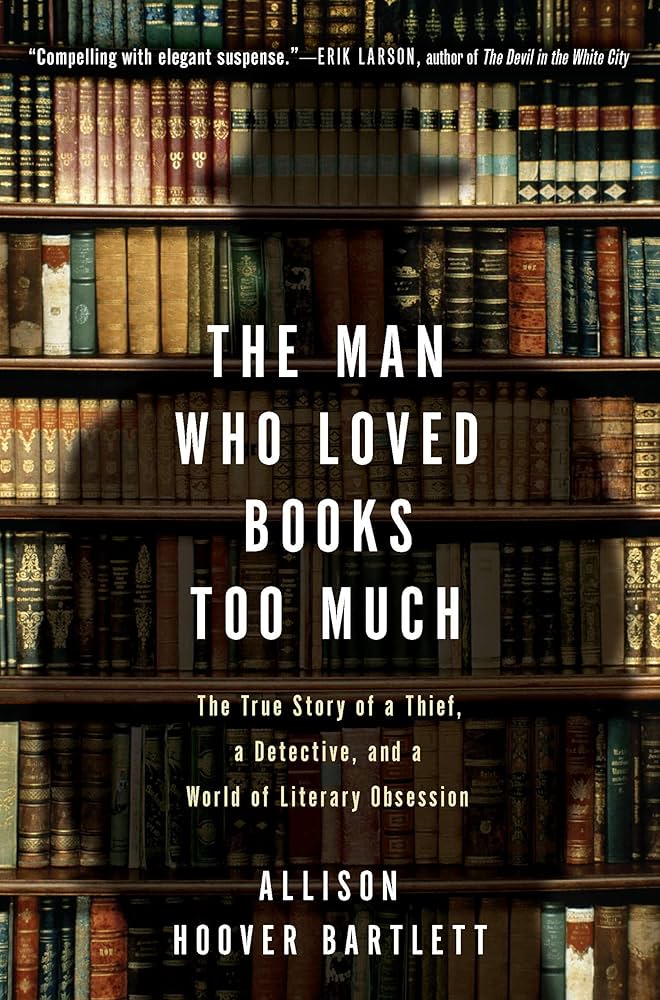
There are crimes that announce themselves with sirens and headlines, and there are those that whisper among the stacks — small betrayals that leave only a missing spine, a ghosted catalog entry, a faint fingerprint on the margin of an otherwise quiet life. Paper Trails and Passion opens on that quieter kind of transgression,guiding the reader into allison Hoover Bartlett’s inquiry of obsession,expertise,and the fragile economy of rare books in The Man Who Loved Books too Much. The book reads like a map of disappearing places: auction rooms, private collections, and the intimate, sometimes lonely laboratories of bibliophiles whose affections for paper can blur into compulsion.
Bartlett’s narrative threads together the chase and the culture that enabled it. Rather than dwelling solely on theft as a crime, the story foregrounds the peculiar desires that make certain objects precious and the communities that form around their stewardship. In doing so, it raises questions about ownership, value, and the thin line between devotion and theft — questions this review will explore without rushing to judgment.
What follows is a closer look at how Bartlett balances portrait and puzzle: the human psychology of her central figures, the procedural glue that links them, and the portrait of a collecting world that is at once meticulous and vulnerable. Read as both cautionary tale and elegy, the book invites readers to consider not just what we keep on our shelves, but why we keep it there.
A claustrophobic lens on obsession and books exploring how a private passion for rare volumes escalates into criminal compulsion and public scandal
The narrative squeezes the reader into a single room of obsession: lined shelves, clipped accession notes, and a private ledger that reads more like a confessional than an inventory. In these cramped interiors every crease in a page becomes evidence and every purchase, a small triumph and a fresh wound. The protagonist’s devotion is methodical and oddly tender—hours spent cataloging bindings, a ritual whisper to a newly acquired first edition—yet these quiet acts carry an undercurrent of danger. Private passion mutates into a hunger for completion, and the bookish routines that once soothed begin to dictate riskier choices. Consider the common markers that signal the slide from collecting to consuming:
Best-Selling Books in This Category


- Sleepless nights spent tracking provenance
- Secretive correspondence with shadowy dealers
- Inventory that blurs into fixation
Each item feels small on its own, but together they tighten the atmosphere until there is barely room left for anything but the next acquisition.
When appetite and prospect align, margin notes give way to moral margins: forged signatures, illicit removals, auctions gamed to conceal a pattern. The book world,once an intimate refuge,turns public and punitive as whispers harden into headlines. The story examines how criminal compulsion grows out of aesthetic longing and how that compulsion,when exposed,becomes a spectacle—libraries audited,dealers prosecuted,reputations torn like brittle paper. Below is a simple map of that becoming, the stages readers witness again and again:
| Stage | Behavior | Consequence |
|---|---|---|
| Private | Quiet collecting | Solace |
| compulsion | Risk-taking to acquire | Guilt, secrecy |
| Exposure | Forgeries/thefts revealed | Public scandal |
The tone remains clinical but humane: empathy for why one loves books, and clear-eyed scrutiny of what that love can become when it is indeed hoarded, hidden, and weaponized.
Mapping the investigative arc detailed evidence threads and courtroom drama that reveal the toll of bibliomania on collectors dealers and families

Investigators in this story unspool a maze of receipts, annotations and late-night emails until the strands cohere into a portrait of compulsion and cunning. Through paper trails,catalogue inconsistencies and the quiet language of provenance marks,the book maps how small curiosities escalate into criminal patterns — and how meticulous collectors become both sleuths and suspects. Evidence arrives in unexpected forms:
- Catalog anomalies and erased stamps
- Unexplained bank transfers and dummy invoices
- Handwritten notes that contradict provenance
When the case reaches the courthouse the tone shifts from archival fascination to human reckoning: courtroom transcripts lay bare motivations, betrayals and the calculus of greed. The drama isn’t only legal; it is indeed personal — dealers lose reputations, families confront secrecy, and collectors reckon with the moral cost of obsession. The book frames these outcomes with sober detail, showing consequences that are both material and intimate:
- Financial restitution and ruined careers
- Fractured relationships and trust lost
- Institutions tightening acquisition policies
Character portraits that refuse easy sympathy examining the thief the victims and the complex emotional commerce behind coveted first editions and manuscripts
He moves through stacks like a pilgrim, hands lingering where others glance; the thefts read less like crimes than confessions. What makes him compelling is not remorse but a particular hunger—an appetite for provenance, marginalia, the residue of a previous reader’s breath on a page. Those who chronicle him offer fragments rather than absolution: a portrait of someone for whom possession feels like conversation, and who believes that an orphaned first edition can be coaxed back into the kind of intimacy it once had. Sympathy is withheld because his acts unravel more than property lines; they pull at the social contracts that bind memory to place.
- Thief — meticulous, reverent, often acting as self-appointed curator.
- Collectors — anguished by loss, sometimes complicit in the mythology surrounding stolen rarities.
- Librarians & heirs — custodians of stories who measure damage in missing narratives as much as in market value.
The commerce surrounding coveted manuscripts is less a market than an economy of feeling: auctions convert longing into ledger entries, dealers translate grief into replacement estimates, and victims catalog absence as a new kind of knowledge. This is emotional commerce where provenance, gossip, and the scar of loss trade hands alongside catalog numbers; it creates a ledger in which every entry is both factual and elegiac. The result is a cast of characters who refuse to be neatly categorized—players in a system that values paper not only for rarity but for the histories it can still whisper.
| Object | Loss | Aftermath |
|---|---|---|
| 1830 First | Provenance severed | Heir’s ritual cataloging |
| Author’s draft | Annotations erased | Scholarly speculation |
| Inscribed copy | Family memory lost | Public appeal |
Balancing true crime tension with bibliophilic detail assessing whether the narrative elevates moral hindsight or humanizes compulsive desire for rare texts
There is a careful tightrope walked between the snap of investigative disclosure and the warm, almost obsessive intimate detail of bindings and provenance. The book’s reporting leans into sensory specificity—the scent of foxed paper, the hiss of a slipcase, the subtle stamp of a dealer’s mark—so often that crime scenes themselves feel catalogued rather than merely recounted. That choice softens the usual whip-crack tempo of true crime and invites a quieter dread: curiosity becomes culpability. Consider how the narrative uses small moments to shift outlook from the act to the appetite, illustrated by elements such as
- the meticulous listing of first editions as if inventorying evidence
- the slow reveal of auctions and private libraries that read like maps of desire
- the way obsession is tracked in marginalia and purchase receipts
Each detail is a lens—sometimes clarifying, sometimes obfuscating—so that tension is not only about the who and the how, but about what it costs to love a thing beyond measure.
the result is an ethical mirror that refuses simple judgment: the book alternates between moral hindsight and compassionate portraiture, asking whether we condemn the crime or pity the compulsion. A concise comparison helps to see the purposeful balance the author strikes:
| Moral Hindsight | Humanizing Desire |
|---|---|
| Legal and ethical frames | Psychology of collecting |
| Consequences emphasized | Tenderness toward compulsion |
This synthesis doesn’t absolve or indict outright; rather it asks readers to weigh the magistrate’s ledger against the bibliophile’s ledger. The net effect is subtle: the narrative elevates the lesson without erasing the humanity that made theft imaginable,and in doing so it forces us to reckon with how passion can both ennoble and unmoor a person.
Archival richness and descriptive precision evaluating the bookish minutiae that will delight collectors librarians and anyone fascinated by material culture
ink-stained clues and the faint ghost of a thumbprint on the frontis tell a story the narrative never fully encodes: here, paper is witness. Small archival details—page-edges trimmed inexpertly, a penciled acquisition date in a back flyleaf, the ghost of a catalogue ticket still glued to a pastedown—become characters in their own right, each micro-evidence widening the portrait of obsession. For collectors and librarians the pleasure is forensic and aesthetic at once: the texture of the board, the smell of binding glue, the cadence of hand-copied errata slips reveal a private history that no biography can fully capture.
- Provenance marks: bookplates,inscriptions,auction labels
- Physical quirks: deckled edges,foxing patterns,sewing style
- catalog breadcrumbs: card-catalog numbers,accession stamps,library of Congress notations
Descriptive precision converts that tactile richness into a language that survives generations: concise condition terms,consistent collation formulas,and carefully recorded anomalies let a single entry stand for an object’s lived materiality. Archivists and bibliographers delight in translating stains and repairs into searchable metadata—an alchemy that turns scent and shade into provenance, market value, and scholarly lead. In the hands of a meticulous cataloguer, even the smallest marginalia becomes a pointer to networks of taste and theft, devotion and decay.
| Field | Example |
|---|---|
| Binding | Original cloth, gilt rubbed |
| Provenance | Ex libris: H. Adelman (1924) |
| Condition note | Frontis torn, repair to hinge |
Ethical questions for readers and institutions proposing concrete recommendations for collectors libraries and dealers to prevent theft and protect provenance
Collecting and conserving rare books sits at a crossroads of reverence and risk: admiration can slip into acquiescence when the story behind an object is murky. Readers and institutions are asked to treat every volume not merely as an artifact but as evidence—evidence of ownership, movement, and sometimes wrongdoing.The most pressing ethical tensions revolve around access versus protection, the scholar’s right to study versus the community’s right to restitution, and the temptation to prioritize market value over origin.A sober, curious approach—one that treats provenance as central to a book’s worth—helps transform passion into duty without smothering the joy of finding.
- Provenance audits: Regular, documented reviews of acquisition histories and donor claims.
- Transparent policies: Public acquisition and deaccession guidelines that include redress mechanisms.
- Shared registries: participation in national and international stolen-art databases and interlibrary alerts.
- Digital stewardship: High-resolution imaging,metadata standards,and visible chain-of-title records.
- Secure lending protocols: Conditional loans with clear responsibilities for security and return.
- Ethics training: Staff and dealers educated on legal obligations, cultural sensitivity, and whistleblower safeguards.
| Actor | Swift Action |
|---|---|
| Collectors | Commission independent provenance checks |
| Libraries | Publish acquisition logs annually |
| dealers | Verify and document chain-of-custody |
Narrative techniques pacing and structure judged for clarity dramatic buildup and the seamless weaving of interviews and confessions into readable storytelling

Every chapter in the film reads like a meticulous ledger: selective, paced, and deliberately arranged to let tension accumulate without ever feeling rushed. Scene lengths breathe when we need room to take in atmosphere; they tighten into staccato bursts as clues click into place. The result is a rhythm that balances graceful exposition with surgical edits — a structure that lets the viewer trace obsession like a footprint in fresh snow. To achieve this clarity the filmmakers rely on a few simple rules that repeat throughout the piece:
- Anchor moments — recurring visual or verbal motifs that orient the viewer.
- Breath spaces — slow, quiet scenes that allow emotional register to deepen.
- Punctuated reveals — small illuminations scattered rather than a single climax.
The spoken testimonies and private confessions are threaded in with the same disciplined touch: interviews are trimmed to reveal character in micro-gestures, confessions are layered against archival detail to create echoes of motive rather than expository dumps. Editors treat voice as texture — alternating first-person admissions with observational voiceovers to produce a conversational counterpoint that reads as much as it listens.The interplay can be mapped simply:
| Technique | Effect |
|---|---|
| Cross-cutting confession with catalog visuals | Turns testimony into evidence, heightening suspense |
| Selective silence after a reveal | Allows the viewer to inhabit doubt |
| Refrain-like callbacks | Creates coherence across episodic beats |
What this book teaches about the psychology of collecting with suggested further reading resources and practical tips for safer acquisition practices
- To have and To Hold — essays on attachment and possessions
- Buried in Books — case studies of bibliomania and recovery
- Mind Over Matter — cognitive biases that fuel hoarding
These resources pair psychological insight with storytelling,helping readers spot the warning signs and appreciate the subtle pleasure that makes collecting irresistible.
| Risk | Safer Practice |
|---|---|
| Forged items | Authenticate with experts |
| Legal issues | Check ownership history and export rules |
| Financial overreach | Set a separate acquisition fund |
And a few quick habits to cultivate:
- Pause: wait 48 hours before bidding or buying big.
- Document: photograph and catalog new additions instantly.
- Consult: join collector forums and get second opinions from trusted dealers.
These steps protect both you and the cultural artifacts you love, turning obsession into a sustainable, ethical practice.
Audience guide and reading contexts recommending who will gain most from this book from true crime fans to rare book curators and nonfiction readers
For readers who crave the smell of old paper as much as a slow-burn mystery, this volume is a rare treat. True crime fans will appreciate the knotty obsession at the heart of the story,while bibliophiles and rare book curators will be fascinated by the technicalities of collecting,theft,and provenance. It also speaks to nonfiction readers who favor narrative depth over quick thrills, and to librarians, archivists, and historians who enjoy case studies about cultural preservation. Consider these readers especially primed for the book’s blend of scholarship and suspense:
- True crime aficionados — for the investigative momentum and moral puzzles.
- Book collectors & curators — for the insider details on rarity and value.
- Nonfiction storytellers — for the craft of balancing research and narrative.
- Students of ethics or cultural history — for questions about ownership and legacy.
Best enjoyed in contexts where curiosity and conversation can flourish: an evening read that keeps you looking over your shoulder,a university seminar on material culture,or a book-club pick that will provoke heated debate about obsession and stewardship. Below is a quick guide to ideal reading contexts with why each fits — perfect for planners, educators, and event organizers who want to stage an engaging discussion or exhibit.
| Setting | Why it fits |
|---|---|
| Night reading | Heightens the novel-like suspense and intimacy. |
| Book clubs | Generates debate on obsession, ethics, and value. |
| Museums & archives | Pairs well with exhibits about collecting, theft, and preservation. |
About Allison Hoover Bartlett her investigative background literary sensibility and why her reporting brings nuance authority and compassion to this book

Allison Hoover Bartlett brings the kind of investigative rigor that reads like scholarship and the instincts of a storyteller who knows which paper trail to follow and which human face to linger on. Years of newsroom investigation—digging through auction records, court dockets and private correspondence—give her reporting an authority that never feels showy; it is the quiet confidence of someone who has done the hard, methodical work so readers don’t have to.Her reporting is driven by meticulous documentation and a talent for coaxing testimony from wary sources, a mix that allows her to reconstruct not just what happened but how choices and obsessions unfolded over time.
- Document-first approach — archival evidence anchors narrative claims.
- Source cultivation — interviews that reveal motive without spectacle.
- Contextual clarity — legal, cultural and market forces rendered plainly.
- Humanized focus — compassion for victims and subjects alike.
Her literary sensibility—clean sentences, precise scene-setting and an ear for the odd, telling detail—transforms cold records into a textured human story. That balance of craft and conscience is why her account feels both nuanced and fair: the book holds firm to evidence while remaining attentive to the moral ambiguities and small violences that statistics alone erase. In short, readers get reporting that is authoritative without being aloof, rigorous without being heartless, and richly humane without sacrificing clarity.
| Trait | How it appears in the book |
|---|---|
| Curiosity | Tracing obscure ledgers to reveal a pattern |
| empathy | Portraits that honor victims’ voices |
| Precision | Clear timelines that resist sensationalism |
Paper Trails and Passion: Inside “The Man Who Loved Books Too Much” leaves you with the strange comfort of a well-worn bookmark — the story’s edges are scuffed, its margins full of notes, and its central mystery still lingers between the pages. Whether you come for the true-crime drama, the portrait of obsessive love for the printed word, or the ethical puzzles spun around ownership and desire, the book refuses to let its subjects be easily sorted into hero or villain. It instead asks readers to sit with the messiness of human attachment: to objects,to stories,and to the identities those attachments create.
If you seek a tidy verdict,you won’t find one here. What you will find is a meticulous reconstruction of lives bound up in paper and passion, and an invitation to consider what we value — and why. Close the cover and you may find that the paper trail continues in your own thoughts, a quiet echo of curiosity and caution that nudges you toward the next shelf, the next story.