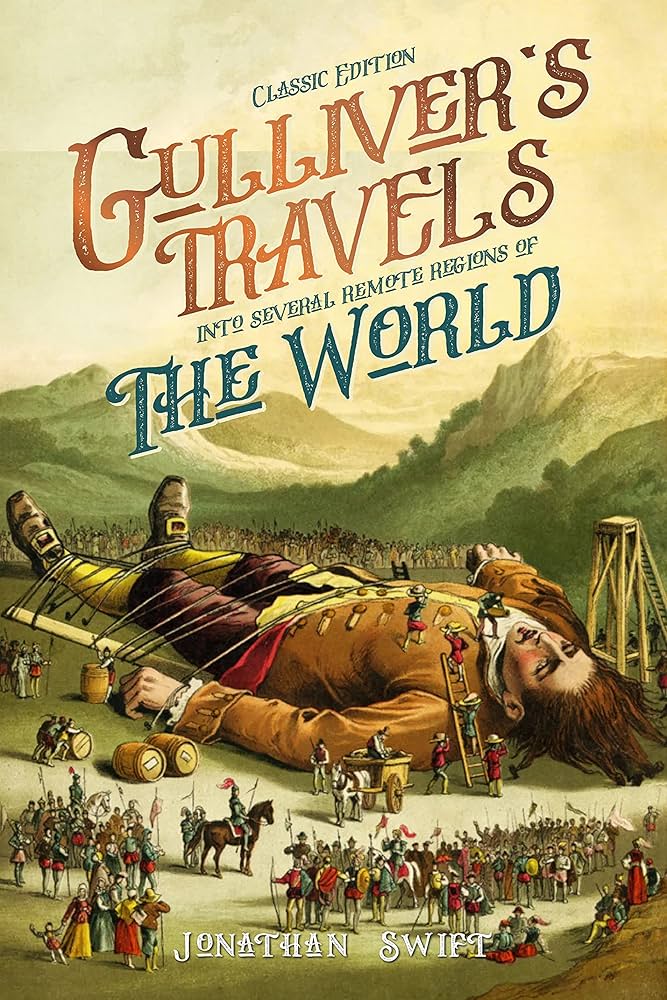
In the landscape of English literature, few works wield satire with the precision and power found in Jonathan Swift’s Gulliver’s Travels and A Modest Proposal. these texts, though distinct in form and approach, converge in their unflinching examination of society’s follies and moral paradoxes. Delving into Swift’s biting wit and imaginative narratives, this review explores how his satire transcends mere humor to become a sharp instrument of social critique. By unpacking the layers of irony,exaggeration,and moral urgency embedded within these works,we gain a deeper understanding of swift’s enduring relevance and his bold challenge to the values of his time.
The Art of Satire Unveiled Through Swift’s ingenious Narrative Techniques and Sharp social Commentary

Jonathan Swift masterfully combines irony, exaggeration, and parody to construct a vivid tapestry of satire that uncomfortably mirrors the flaws of his society. In Gulliver’s Travels, his narrative technique oscillates between absurdity and meticulous observation, allowing readers to explore the absurdity of human nature and institutions through fantastical voyages. The intricate layering of fictional cultures, such as the diminutive Lilliputians and the towering brobdingnagians, reveals the pettiness, pride, and corruption inherent in political and social structures. This imaginative framework acts as both a shield and a sword-engaging readers while critically slicing through complacency and self-importance.
Meanwhile, A Modest Proposal wields satire with sharpened precision, employing shock value and deadpan rationality to expose the inhumanity lurking beneath political and economic discourse. Swift’s rhetorical strategy invites readers into a chilling logical progression, where the grotesque becomes disturbingly plausible, forcing a confrontation with societal neglect and apathy. The following table summarizes key narrative techniques Swift uses to craft his biting social criticism:
Best-Selling Books in This Category


| Technique | description | Effect on Reader |
|---|---|---|
| Irony | Contrasting literal meaning with intended criticism | provokes critical reflection and amusement |
| Exaggeration | Amplifying societal flaws to absurd extremes | Highlights injustice through discomfort |
| Parody | Imitating literary and political forms mockingly | Undermines authority and challenges orthodoxy |
| Logical Progression | Building disturbing ideas step-by-step | Engages reader’s reason to reveal moral failures |
Through this strategic arsenal, Swift compels his audience to not only recognize but also question their complicity in societal ills. His satire transcends mere humor, becoming a potent instrument of social awareness and moral urgency, wrapped in layers of wit and narrative ingenuity.
How Gulliver’s Travels Uses Imaginary Worlds to Critique 18th Century Politics and Human Nature

Jonathan Swift masterfully constructs fantastical realms as a reflective mirror to the absurdities within 18th-century politics and human folly. In *Gulliver’s Travels*, each imaginary land-from the minuscule Lilliputians to the colossal Brobdingnagians-functions as a symbolic stage where the follies of governance, social customs, and human pride are exaggerated to an almost surreal degree. these surreal landscapes allow readers to distance themselves from contemporary reality, opening a space where critical analysis can flourish without direct confrontation. Through these imaginative settings, Swift exposes the pettiness of political conflicts, the vacuity of courtly manners, and the dangerous arrogance embedded in human nature.
Key elements Swift critiques through his invented worlds include:
- Political corruption disguised by pomp and ceremony.
- Blind loyalty to trivial disputes and ideologies.
- Human selfishness camouflaged in the name of progress.
| Imaginary World | Satirical Target | human Nature Insight |
|---|---|---|
| Lilliput | Political triviality | Fragility of power structures |
| Brobdingnag | Moral superiority & reason | Vanity and shortsightedness |
| Laputa | Abstract intellectualism | Detachment from reality |
A Modest Proposal as a Masterclass in Dark Satire and Its Unsettling Call for Social Awareness

Jonathan Swift’s A Modest proposal stands as a chilling exemplar of dark satire, boldly wielding irony and grotesque exaggeration to critique the dire socioeconomic conditions of 18th-century Ireland. Unlike traditional satire that employs light-hearted mockery, Swift’s essay shocks readers by suggesting a horrifying solution-consuming Irish infants-to highlight the callousness of the ruling class and the dehumanizing effects of poverty. This unsettling proposal isn’t merely to provoke disgust but to galvanize the public into recognizing the urgent need for compassion and reform. Through its calculated absurdity, the text exposes the moral blindness of those who viewed the poor as mere statistics rather than human beings with dignity.
Swift’s mastery lies in his ability to intertwine biting humor with searing social critique, inviting readers to grapple with uncomfortable truths. His strategy can be broken down into key elements:
- Hyperbolic Reasoning: His “logical” approach pushes cruelty to an extreme, challenging readers to question accepted norms.
- Detached tone: The calm, pseudo-scientific voice masks the horror beneath, amplifying the impact.
- Social Commentary: Every outrageous claim doubles as an indictment of political apathy and economic exploitation.
| Satirical Technique | Purpose | Effect on Reader |
|---|---|---|
| Irony | expose hypocrisy | Evokes shock and reflection |
| Exaggeration | Highlight social neglect | creates discomfort leading to awareness |
| Detached Narration | maintain credibility while delivering critique | Amplifies unsettling tone |
Examining the Role of Irony and Exaggeration in Conveying swift’s Moral and political Messages
Swift masterfully employs irony as a scalpel, dissecting the absurdities of human nature and societal flaws. In both Gulliver’s Travels and A modest Proposal, irony serves not merely as humor but as a sharp critique that exposes the bitter truths lurking beneath polite discourse. This layered irony encourages readers to question dominant political narratives and moral complacencies. As an example, Swift’s voice in A modest Proposal is deliberately detached and clinical, presenting the outrageous suggestion of selling children for food as if it were a reasonable economic solution. This dissonance between the horrific content and the calm tone forces the audience to confront the inhumanity of contemporary policies toward Ireland’s impoverished, turning shock into reflection.
Exaggeration amplifies Swift’s moral messaging by stretching reality into grotesque caricature, making societal shortcomings impossible to ignore. Elements such as the tiny Lilliputians’ inflated political disputes or the giant Brobdingnagians’ simple moral clarity create stark contrasts that illuminate the pettiness or cruelty of human institutions.The table below highlights key examples of how exaggeration operates to reveal deeper truths:
| Exaggerated Element | Purpose | Effect |
|---|---|---|
| lilliputian Political Quarrels | Highlight triviality of human conflicts | Ridicule petty nationalism and partisanship |
| Gulliver’s Size in brobdingnag | Contrast moral perspectives | Expose human vices as grotesquely small-minded |
| Proposal to Eat Irish Children | Shock with hyperbolic solution to poverty | Critique British neglect and indifference |
- Irony teases out the hypocrisy embedded in political rhetoric.
- Exaggeration turns societal critiques into vivid, unforgettable images.
- Both techniques work together to make readers uneasy and contemplative.
The Impact of Swift’s Satirical Style on Contemporary Readers and Its Lasting Influence on Literature
Jonathan Swift’s satirical mastery challenges contemporary readers by pushing them to confront uncomfortable societal truths through irony and exaggeration. His biting wit, especially evident in gulliver’s Travels and A Modest Proposal, compels audiences to look beyond surface narratives and question the moral fabric of their own times. Swift’s use of satire is not merely for humor; it acts as a mirror reflecting hypocrisy,greed,and injustice. Modern readers continue to find relevance in his works because they illuminate enduring human follies, making his sharp critiques both timeless and profoundly unsettling.
- Provocative narrative techniques that engage readers emotionally and intellectually.
- Subversion of expectations to highlight societal absurdities.
- Complex layering of meaning encouraging multiple interpretations.
The lasting influence of Swift’s satirical style is visible across contemporary literature, shaping how authors approach social criticism. His pioneering capacity to blend humor with harsh truths set a blueprint for future satirists, enabling them to balance entertainment with advocacy. The table below illustrates key elements of Swift’s satire that continue to inspire literary voices today:
| Element | Purpose | Modern Request |
|---|---|---|
| Exaggeration | Highlight absurdity of societal norms | Used in dystopian fiction and political cartoons |
| Irony | Expose contradictions and hypocrisy | Common in contemporary essays and stand-up comedy |
| Parody | Critique cultural and literary conventions | inspires satire in film and digital media |
Dissecting Swift’s Critique of Class, Power, and Hypocrisy Within British and Irish Society
Jonathan swift masterfully wields satire as a scalpel, peeling back the layers of class distinctions and systemic power imbalances entrenched within British and Irish societies. In gulliver’s Travels, the absurd extremes of the Lilliputians mirror the pettiness of aristocratic disputes, while the Houyhnhnms’ rational world starkly contrasts with the corrupt humanity below. Swift does not merely ridicule the elite; he exposes the hypocrisy that allows them to perpetuate inequality under the guise of civility and progress.Through vivid allegory, he critiques how power consolidates around a privileged few, often disguising cruelty and greed as governance and wisdom.
Similarly, A Modest proposal shocks the reader with its grotesque suggestion – selling impoverished Irish children as food – forcing society to confront its moral bankruptcy and indifference toward suffering.The proposal’s biting irony unmasks the exploitative attitudes of the English ruling class while condemning the passivity of local elites who, complicit in their own people’s subjugation, prioritize economic gain over human dignity. Below is a comparison of the key societal critiques present in both works, highlighting Swift’s multifaceted analysis of power and class:
| Aspect | Gulliver’s Travels | A Modest Proposal |
|---|---|---|
| Class | Satire of aristocratic pride and petty nobles | Exposes plight of impoverished Irish peasants |
| power | Critiques absolutism and flawed governance | Condemns exploitative colonial policies |
| Hypocrisy | Mocks moral pretensions of “civilized” society | Highlights indifference cloaked in ‘rational’ charity |
- Allegorical storytelling to dissect social absurdities.
- Irony and exaggeration to provoke critical reflection.
- Social conscience embedded within dark humor.
Comparative Analysis of Characterization and Symbolism in Gulliver’s Travels and A Modest Proposal
Jonathan Swift employs characterization in both Gulliver’s Travels and A Modest Proposal to craft stark mirrors reflecting 18th-century society’s follies. In his novel, Gulliver’s encounters with fantastical civilizations serve as allegorical extensions of human nature-each society represents different facets of political and intellectual absurdities. For instance, the diminutive Lilliputians symbolize petty political squabbles, while the Houyhnhnms embody a distorted vision of rationality and moral superiority. In contrast, A Modest Proposal uses minimal character scope, focusing intensely on the persona of the speaker whose cold, calculated logic exposes the callous attitudes toward Irish poverty. This contrast highlights Swift’s versatility in using characterization not just as a narrative tool, but as a method to infuse his satire with biting social critique.
Symbolism in both works serves to deepen the resonance of Swift’s social commentary. In Gulliver’s Travels, symbols like the broken sword of the Yahoos and the meticulous courts of the Houyhnhnms represent humanity’s dual capacity for savagery and civility. Conversely, A Modest Proposal transforms the abhorrent suggestion of infanticide into a grotesque symbol of economic exploitation and colonial neglect. The following table outlines key symbolic elements and their implications across the two texts:
| Symbol | Gulliver’s Travels | A Modest Proposal |
|---|---|---|
| Yahoos | Human base instinct and depravity | N/A |
| Houyhnhnms | Idealized reason and order | N/A |
| infant Consumption | N/A | Extreme commodification & socioeconomic neglect |
| Political Satire | Exaggerated courts and petty rivalry | Proposed solution mocking British policies |
- Characterization transforms abstract social criticism into tangible narrative forces across diverse genres.
- Symbolism enriches irony and deepens readers’ understanding of societal flaws.
- Swift’s use of both devices reveals a layered and uncompromising exploration of humanity’s contradictions.
Recommendations for Readers Seeking to Understand Satire’s Power in Literature and Social Critique
To truly grasp the formidable power of satire as wielded by Jonathan Swift, readers should immerse themselves not only in the narratives but in the *contextual ironies* that underpin his works. gulliver’s Travels and A Modest Proposal are masterpieces of layered critique, revealing societal absurdities by cloaking harsh truths in wit and exaggeration. Engaging with secondary sources-historical backgrounds, literary analyses, and contemporaneous reactions-will unravel the nuanced dialog Swift initiates between his fiction and the real world. This multidimensional approach invites readers to appreciate satire as more than humor; it is indeed a scalpel dissecting social hypocrisies and moral blindness.
For those eager to explore satire’s mechanisms, consider focusing on these elements:
- Irony and Paradox: notice how Swift’s use of contradictions exposes deeper societal flaws.
- Exaggeration as Reflection: See how grotesque magnification of issues serves as a mirror to real injustices.
- Target identification: Identify who or what Swift aims to criticize-governments, social classes, or human nature itself.
- Subversion of Norms: Observe how established norms and values are challenged to provoke thought and discomfort.
| Satirical element | Purpose | Example from Swift |
|---|---|---|
| Hyperbole | Amplify absurdity | Proposal to eat children in A modest Proposal |
| Allegory | Symbolize societal issues | lilliputians’ petty politics in Gulliver’s Travels |
| Sarcasm | Convey contempt under humor | Swift’s polite tone masking savage critique |
Exploring the Ethical Boundaries and Reader Responses to Swift’s Provocative Satirical Approach
Jonathan Swift’s satirical genius cuts deep,often treading the fine line between incisive social critique and ethical provocation. His use of shocking imagery and hyperbole-especially in A modest Proposal-forces readers into a confrontational space where laughter mingles with discomfort.This purposeful unease serves a dual purpose: it disrupts complacency while urging introspection about societal injustices. Readers are compelled to question not only the issues Swift exposes but also their own complicity in the structures enabling such problems. Yet, this approach has sparked controversy, with some accusing Swift of obscenity or moral insensitivity, demonstrating how satire’s ethical boundaries are often as contentious as its content.
The varied reader responses to Swift’s provocations highlight the complex role satire plays in public discourse. Common reactions include:
- Admiration for his fearless exposure of hypocrisy and cruelty.
- Shock at the graphic and unsettling nature of his proposals.
- Confusion stemming from the blurred lines between literal and ironic intent.
- Rejection by those who perceive the satire as offensive or nihilistic.
Below is a creative summary table illustrating typical reader responses and their ethical considerations:
| Reader Response | Ethical Concern | Implication for Satire |
|---|---|---|
| admiration | Respect for critical honesty | Validates satire as truthful social mirror |
| Shock | Discomfort with graphic content | Ensures attention but risks alienation |
| confusion | Ambiguity in message | Challenges readers to interpret deeper meaning |
| Rejection | Perceived moral offense | Tests limits of acceptable critique |
The Continued Relevance of Swift’s Satirical Works in Modern Conversations About Society and Morality
Jonathan Swift’s masterful use of satire transcends centuries, continuing to resonate as a powerful tool for critiquing societal norms and ethical dilemmas. His works invite readers to peer beneath the surface of polite discourse and question the underlying hypocrisies and moral failures that persist in contemporary society. Take, for example, Gulliver’s Travels, which employs fantastical voyages to far-off lands as allegories for political absurdities and human folly, encouraging modern audiences to reflect on the irrationalities still present in governance, social hierarchy, and human nature.
Similarly, A Modest Proposal confronts issues of poverty and indifference with a shockingly provocative tone that forces uncomfortable conversations on exploitation and morality. The enduring power of Swift’s satire lies in its ability to:
- Use irony to expose systemic injustices
- Prompt critical thinking about accepted societal values
- Challenge complacency through uncomfortable truths
| Theme | Modern Parallel | Satirical Technique |
|---|---|---|
| Political Corruption | Partisan polarization | Exaggeration |
| Social Inequality | Wealth gap debates | Sarcasm |
| Human Vanity | Social media narcissism | Parody |
Analyzing the Narrative Structure and Language that Amplify Satire’s Effectiveness in Both Works
Swift’s mastery in narrative structure serves as a powerful vehicle for satire, artfully steering readers through complex societal critiques without sacrificing engagement. In Gulliver’s Travels, the episodic journeys function as satirical vignettes, each targeting different facets of human folly-from the petty politics of Lilliput to the cold rationalism of the Houyhnhnms. The fragmented yet cohesive structure allows Swift to juxtapose absurdity and reason, guiding readers to question the assumptions embedded in Enlightenment thinking. Conversely, A Modest Proposal employs a tightly contained, linear argument to crescendo toward its horrifying conclusion, using the format of a clinical economic report to mock British apathy toward the Irish poor. This strategic framing-whether sprawling or concentrated-enables Swift to embed his criticism beneath layers of irony and detachment, compelling readers to engage critically rather than passively consume.
Language intensifies this effect through the deliberate use of tone, diction, and rhetorical devices that amplify satire’s sting. Gulliver’s observant yet naive voice, replete with formal elegance and exaggerated politeness, contrasts with the absurdities he encounters, creating a dissonance that heightens the caricature of humanity’s shortcomings. In A Modest proposal, Swift’s cold, logical prose paradoxically elevates the grotesque suggestion, a technique that shocks and unsettles by camouflaging cruelty in reasoned calm. Key rhetorical tools like verbal irony, hyperbole, and parody permeate both works, transforming language into a razor-sharp instrument that slices through complacency. Below is a comparison of narrative and language elements across the two works:
| Element | Gulliver’s Travels | A modest Proposal |
|---|---|---|
| Narrative Style | Multi-layered episodic journey | Single-outlook satirical essay |
| Voice | Naive, observational | Detached, analytical |
| Purposeful Tone | Ironical, critical yet humorous | Cold, logical, confrontational |
| Rhetorical Devices | Parody, exaggeration, irony | Verbal irony, hyperbole, satire |
Insights into Jonathan Swift’s Life and Experiences That Shaped His Visionary Satirical Masterpieces
Jonathan Swift’s upbringing and turbulent personal experiences played a pivotal role in molding the sharp wit and keen observation that characterize his literary works. Born into a modest Anglo-Irish family, Swift’s exposure to the political unrest and social stratification of 18th-century Ireland deeply influenced his perspective.his early education at Trinity college Dublin provided the foundation for his classical knowledge, but it was his career as a clergyman and his involvement with political pamphleteering that truly honed his satirical voice. Encounters with corruption, poverty, and colonial exploitation fueled his desire to expose human folly and societal flaws through biting satire. These elements are palpably woven into the vivid landscapes and exaggerated civilizations of Gulliver’s Travels, where Swift critiques everything from petty politics to the absurdity of human nature.
Swift’s keen social commentary is further illuminated in a concise comparison of the key personal influences and societal contexts that shaped his masterpieces:
| Aspect | influence on satire |
|---|---|
| Political turmoil | Inspired his critique of government inefficiency and power abuse |
| Religious Role | Shaped his moral yet cynical outlook toward human nature |
| Irish Colonial Context | Embedded themes of exploitation and cultural imperialism |
| Personal Hardships | Added emotional depth and dark humor to his proposals and narratives |
These forces intertwined to create a literary style that was both visionary and unflinching, enabling Swift to not only entertain but also provoke critical reflection on the human condition and societal structures. His masterful use of satire continues to resonate because it emerges from genuine experience and profound disillusionment, rather than mere cleverness.
In closing, jonathan Swift’s Gulliver’s Travels and A Modest Proposal stand as enduring testaments to the power of satire to expose the fractures within society. Through his sharp wit and unflinching critique, Swift invites readers to not only laugh at the absurdities he presents but also to reflect on the underlying truths that continue to resonate. These works challenge us to confront uncomfortable realities, reminding us that satire, when wielded with precision, is more than just humor-it is indeed a mirror held up to humanity itself. As we turn the final page, we are left not only entertained but thoughtfully unsettled, compelled to reconsider the world we inhabit through Swift’s piercing lens.