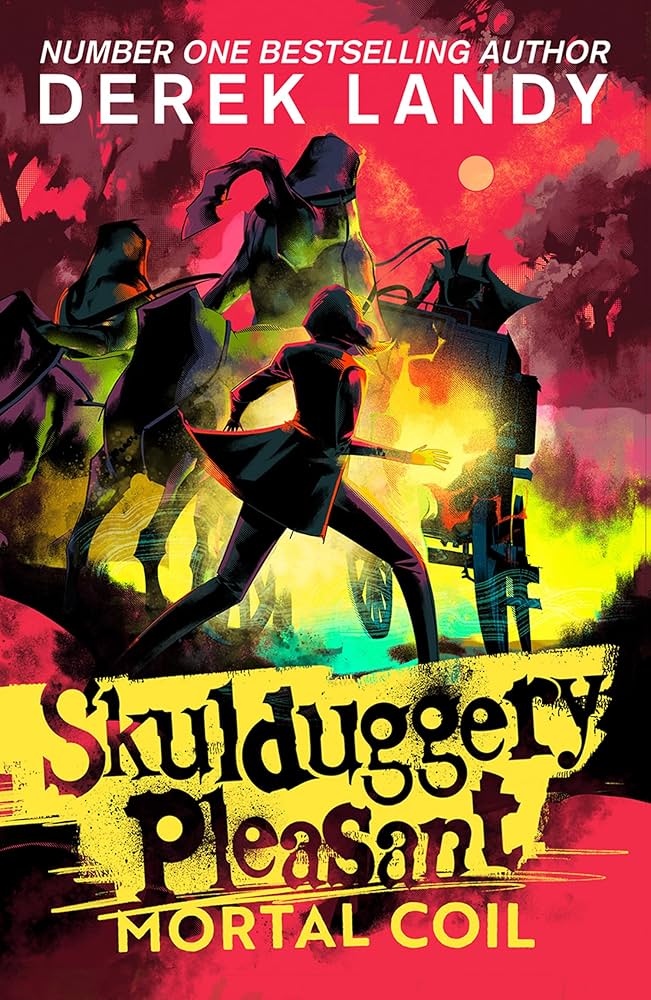
I went into Mortal Coil expecting snappy dialog and a few clever set pieces; what I didn’t expect was how often Derek Landy would make me laugh at something bleak one moment and then make me gasp the next. The book hooked me early with a tone that felt simultaneously playful and a little dangerous, which kept me turning pages to see how far the humor would push before everything shifted.
If you’re someone who enjoys jokes with bite and surprises that land without warning, this felt like a read that balanced those elements in a way that kept me engaged without ever feeling smug or predictable. My first impression settled quickly: this is a book that likes to unsettle you while grinning about it.
First impressions from a rain slicked dublin street scene and a punchy opening

Stepping into the opening felt like being shoved out onto a rain-slicked Dublin pavement at midnight—neon reflections in puddles, the hiss of tires, and a voice that cuts through the drizzle with wry, lethal confidence. Right away I was sold: the scene is cinematic, sharp, and funny in a way that doesn’t undermine the danger. Skulduggery’s one-liners land like flint against wet stone, and Valkyrie’s quiet bewilderment gives the whole thing a human center. It hooked me before I even knew whose side I was on.
Best-Selling Books in This Category


- Amazon Kindle Edition

The punchy opening sets the tone for the rest of the read—equal parts grim and grin-worthy—so when the book slows for explanations later it never loses that initial electricity. I liked how the city itself felt like a character,and how humor kept the stakes emotionally manageable without undercutting them. Small complaint: a few stretches of exposition dilute the momentum the opening builds, but even then I kept turning pages because that first rain-soaked scene promised trouble and kept delivering.
How dark humor lands in tense scenes with blunt jokes and quiet dread
I kept catching myself grinning in the middle of tense scenes — not because the danger had vanished, but because Landy will drop a blunt one-liner in the exact moment you’d expect silence. Skulduggery’s sarcasm and Valkyrie’s offhand replies act like tiny flares: they brighten the mood for a second, then the shadows feel deeper for it.There were times the jokes clipped the tension a bit too quickly, making a scary beat feel almost sitcom-ready, but more frequently enough the contrast made the fear sharper, as if the laugh was a brief, uncomfortable exhale before the next punch landed.
Beyond the wisecracks, it’s the quieter choices that left me unsettled — small, almost domestic details, the pause after a line, a character doing something mundanely human in an inhuman situation. Those moments build a quiet dread that sneaks up on you between the jokes; it’s the kind of unease that lingers after you close the book. if I had a nitpick, sometimes the balance tilts too fast from a joke to a crescendo and I wanted a touch more space to breathe, but overall that clash of blunt humor and slow-burn menace is exactly what made the book feel alive to me.
Twists and surprise reveals that flip the mood from comic to chilling in minutes

I kept laughing at Landy’s one-liners and then, three pages later, felt that funny buzz turn to a chill in my spine. He’s brilliant at turning a jokey line into something ominous by the slightest shift in detail — a throwaway description, a character’s casual glance, or an offhand remark that suddenly reframes everything you thought was safe. Those flips are visceral: one moment I’m grinning at the absurdity, the next I’m reminded that the world in the book has real teeth. That emotional whiplash made me read faster and reread passages to catch the tiny cues I’d missed the first time.
Not every jolt lands perfectly — sometimes the switch feels a little too abrupt, like the mood jumped without enough setup — but more often the contrast is what gives the darker beats thier power. I liked how the humor acts as a softening agent that makes the nastier reveals hit harder: the laughs lower your guard, and when the cold note arrives it stings. The result is a ride that can make you chuckle and then stare at the page in silence, which, for me, was exactly the point.
The main character voice full of snark warmth and surprising vulnerability

Reading Mortal Coil feels like being dragged along by someone who laughs in your face while secretly holding a hand to their chest.The narrator’s snark is constant — clever putdowns, sideways jokes about danger, and an absolute refusal to be sentimental — but it never feels like an act for the reader. That sarcasm is tempered with a real warmth: small acts of loyalty,quiet asides about the people they care for,and a moral stubbornness that makes you want to back them up even when they’re reckless. What surprised me most was how often the tough-talking voice slips into plain, human doubt. Those moments of vulnerability — a weary confession, a sudden quiet — land harder because the default mode is so defiantly loud.
That mix keeps the pages turning. The humour makes darker scenes bearable, and the vulnerability makes the stakes feel personal rather than just plot mechanics.Sometimes the snark stretches a little long in scenes that need emotional breathing, and a few chapters stumble under their own exposition, but overall the voice pulls the book through its twists. By the end I felt like I’d been following a friend who can crack a joke under fire yet still admit when they’re scared — oddly comforting, and surprisingly real.
Secondary characters who steal scenes with oddball quirks and sharp banter
As a reader I found the supporting cast in mortal Coil endlessly entertaining — they pop into scenes with oddball quirks and razor-edged lines that make you grin even as things go sideways. These are the characters who turn a bleak set-piece into something unexpectedly human: the one-liners from a cranky skeptic, the manic energy of an ally who refuses to do things by the book, the quietly bizarre confidant who believes the strangest superstitions. Their voices feel distinct and lived-in, and often they do more than comic relief — they deepen the stakes simply by reacting in ways the protagonists wouldn’t expect.
I kept mentally bookmarking moments where a secondary character took over the scene, whether by a bizarre anecdote, a perfectly timed insult, or a sudden act of loyalty. A few quick standouts that stuck with me:
- a gravel-voiced scoffer whose deadpan lines land like punches;
- a rule-breaking sidekick whose chaotic ideas actually move the plot forward;
- a seemingly offbeat bureaucrat who reveals surprising moral clarity.
My only slight quibble is that sometimes the sharp banter can feel like showboating, briefly flattening emotional beats that needed more room to breathe — but mostly that’s a small price to pay for how much personality these extras bring. They don’t just fill spaces; they steal them, in the best possible way.
Setting and atmosphere packed with neon signs damp alleys and late night diners

The city in Mortal Coil hums with a kind of electric life — neon signs that seem to wink conspiratorially, rain-slick pavements, and damp alleys that smell faintly of oil and old secrets.Walking through those pages felt like trailing the characters under a fluorescent haze,ducking into late-night diners where the booths hold whispered plans and the coffee is always too strong. The setting doesn’t just decorate the story; it amplifies the jokes and the jolts. When a quip lands, the neon makes it sting brighter; when a twist comes, the wet streets make it feel inevitable rather than arbitrary.
As a reader I loved how the atmosphere kept me alert — part noir mood, part cheeky chaos — even if sometimes Landy lingers a beat too long on a glinting sign or a greasy fry-up, which can slow the forward rush. Still, those small pauses often paid off by making the characters’ decisions feel lived-in: you can almost taste the smoke and hear the clink of a spoon as plans go sideways. The world’s grit is used as a kind of shorthand for moral messiness, and for the most part it makes the dark humor hit harder and the surprises stick.
Pacing and momentum that push you through chapters with bursts of adrenaline

I found the pacing merciless in the best way: chapters are clipped and punchy,with a steady parade of white-knuckle hooks that made it hard to stop at “one more.” Landy snaps from a witty exchange to a violent set-piece so quickly that each burst of action feels like an adrenaline shot — there’s little filler, just momentum, and the comic beats land like timing cues that push you forward.
Every now and then that speed works against the book — an emotional moment or subplot can feel rushed or brushed past in service of the next laugh or twist — but overall the propulsion is part of the pleasure. What kept me turning pages most was:
- short, cliffhanger-ready chapter endings
- sharp, rapid-fire dialogue
- sudden reveals that flip the mood from funny to dangerous in a sentence
Even when depth is sacrificed for pace, the ride is exhilarating enough that I raced through the chapters with a grin and a few startled gasps.
How the novel handles death grief and family ties without getting sentimental

I came away impressed by how Landy treats death and mourning like messy, human business rather than a cue for big, shiny catharsis. Most of the emotional punches land because they’re delivered quietly — a tired joke at the wrong moment, a drawer full of photos, an awkward phone call — instead of a tear-soaked monologue.Characters react the way people actually do: they deflect, they get angry, they forget anniversaries, they show up in imperfect ways. That grit keeps the book from tipping into sentimentality; grief is present and persistent, not prettified.
Family ties emerge as a tangle of guilt, loyalty and selfishness, and I liked that the book lets relationships stay complicated. There are warm flashes, but also nagging resentments that don’t magically vanish by the last page. The dark humor helps — it’s not there to soften the blows so much as to show how people cope — and while a couple of emotional scenes could have used more room to breathe, the restraint mostly works. I finished feeling that Landy trusted readers to sit with uncomfortable feelings instead of spoon-feeding tidy resolutions.
Visual set pieces and fight scenes drawn with cinematic panels and sharp detail
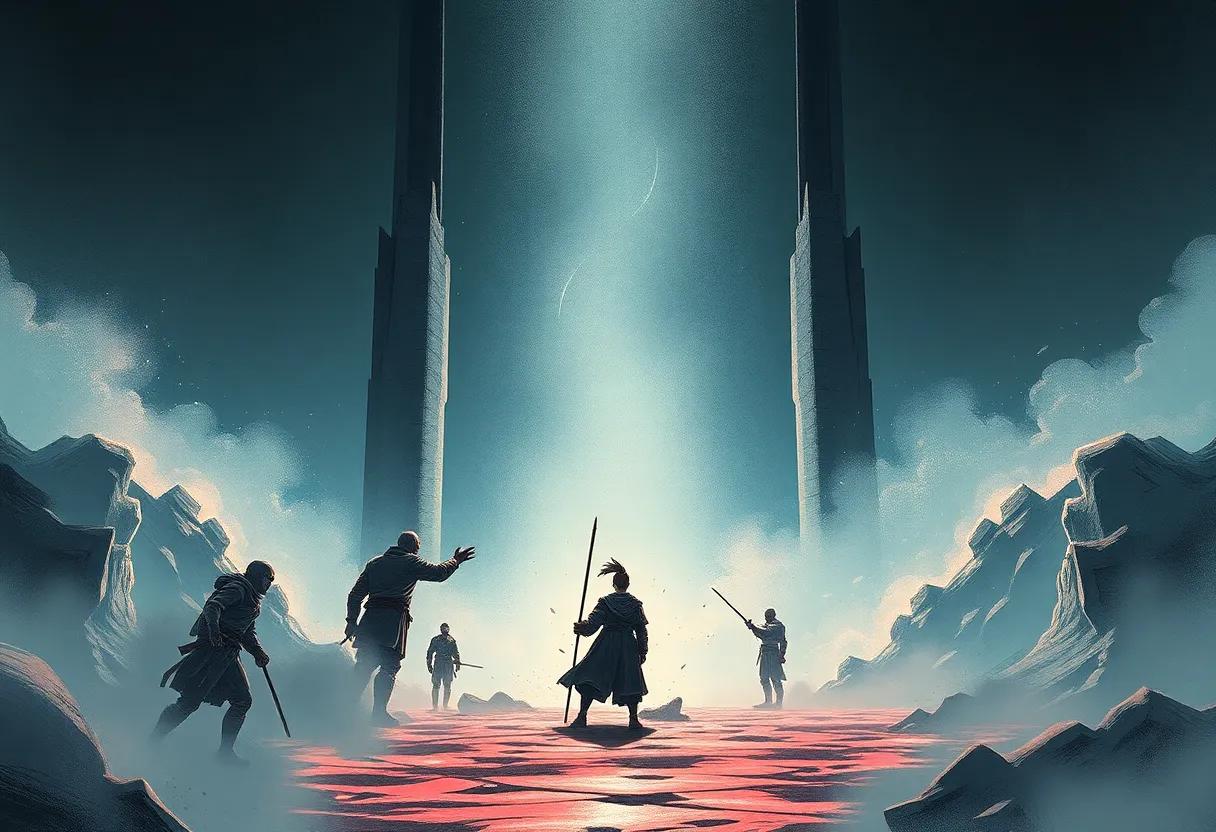
Reading the action felt like flipping through a high-budget storyboard: Landy drops you into frames that are razor-sharp and full of motion. Moments slow down long enough for a grotesque or comic detail to land—an eye-roll, a spray of rain, a flash of teeth—then snap forward so fast you feel the impact.I kept picturing camera moves, close-ups on faces, wide angles that make the city feel like a set piece, and sometimes I had to pause to let an image settle because it was so vivid it stuck in my head.
The fight scenes are where that visual energy pays off most.They’re tightly choreographed, often brutally funny, and staged with an economy that makes the violence feel immediate rather than gratuitous. A few bits sped past so quickly I had to reread to catch a blow or a subtle twist, but mostly the rhythm worked for me—equal parts adrenaline and dark comedy. A few highlights that stuck with me:
- a rooftop scramble that reads like a vertigo-inducing shot sequence
- a diner brawl with perfect, exasperated one-liners
- the final clash, which balances chaos and a surprising emotional anchor
Even when a scene raced too fast, the visual clarity and sharp detail kept me engaged rather than lost.
Derek Landy as a storyteller with wicked timing playful voice and steady craft

Reading Mortal Coil felt like sitting across from a storyteller who knows exactly when to drop a barb and when to let silence do the work. Landy’s wicked timing shows up in tiny moments — a punchline landed in the middle of a dark reveal,or a quiet line that flips your smile into a shiver — and his playful voice makes even the nastiest scenes sing. He never sounds like he’s trying too hard to be clever; the jokes and the horrors both come out of character, which makes them land harder and feel earned.As a reader I laughed out loud and then had to remind myself why I was laughing a few pages later, which is exactly the balancing act I wanted from a book that likes to surprise me.
Steady craft shows in the way scenes are built and in the timing of the twists: he sets up a small detail and later flips it into something deliciously wrong.The emotional beats are quieter than the gags, but they’re there, giving the chaos weight. A few side threads slow the middle stretch and the ending rushes a touch, but mostly the book moves with a confident hand.On balance it made me feel a bunch of conflicting things at once:
- gleeful at the jokes,
- uneasy at the turns,
- eager to see what Landy would do next.
Those mixed reactions are part of the pleasure of reading him — like being on a roller coaster where someone nearby keeps whispering punchlines.
Lingering Echoes of Dark Wit
Reading Mortal Coil is a curious mix of amusement and disquiet — moments that make you laugh aloud sit cheek-by-jowl with scenes that prick at the ribs. The prose moves briskly, and that quick tempo leaves impressions that surface later, in small, unexpected ways.
what lingers most are the voices and the mood rather than specific plot beats: a sharp line, an uneasy twist, a character’s offhand remark that keeps returning to mind. That emotional aftertaste keeps the book alive in memory beyond its pages.
If you enjoy witty, edgy storytelling that steers into darker corners without losing its bite, this will stay with you. It’s the kind of read that invites quiet replays and fresh recognition on a second pass.