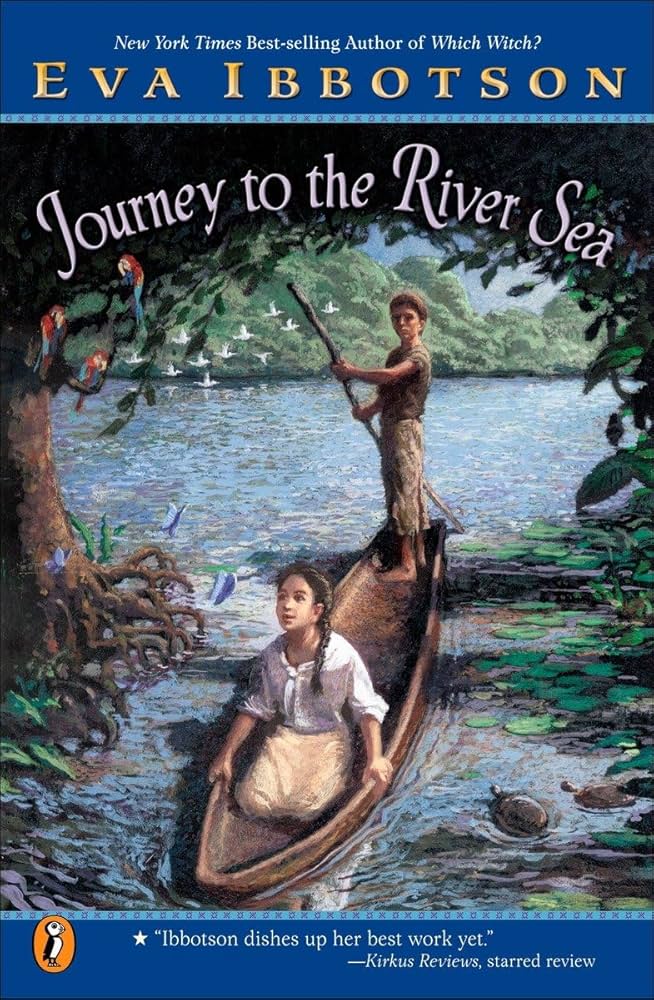
If you remember Eva Ibbotson’s Journey to the River Sea from childhood or are picking it up now, you’ll find it sharper adn kinder than you might expect. When I revisited it recently, I ended up reading late into the evening — not because of flashy twists, but because the characters felt so alive and the small moments kept catching me off guard.
On first impressions, it’s less a dusty classic and more a book that still has things to say about how people behave around one another. That mix of humor, plainspoken warmth, and occasional prickliness is what made me want to reconsider it—and to share that fresh view with anyone thinking of returning to or discovering it for the first time.
Maia and the river town where tropical heat, creeks and mystery shape her days
Reading Maia’s days in that riverside town felt like stepping into a warm, slightly unruly dream. The heat is almost a character itself: heavy, persistent, and somehow comforting, pressing sounds and colors together until everything feels close and significant. Small creeks lace through the place like secret passages, and I kept waiting for one of them to spill open into something utterly unexpected.I loved how the book lets you live in those sensory moments—the slap of rain on tin, the chorus of frogs after dusk, the lazy creak of a boat—though sometimes the pace lingers a bit long in description. Still, those pauses are mostly rewards, not tedium; they let you breathe the place with Maia.
Maia responds to the town the way a child does when the world expands: with suspicion, hunger and a steady curiosity that turns every ordinary errand into a small adventure. The river and its offshoots shape her friendships and her choices—she learns to listen for meaning in the quiet between tides, and the town’s mysteries are never gloomy so much as inviting. A few moments felt contrived,like set pieces asking for resolution,but mostly I found myself rooting for her,glad that the landscape around her is complicated and alive rather than merely pretty. Small, memorable things stayed with me long after I finished reading:
Best-Selling Books in This Category



- Lombardo, Claire (Author)
- the sudden cool of a creek underfoot
- boats that feel as personal as rooms
- and the way heat makes people more honest, more urgent
These are the details that turn Maia’s days into something I’d want to return to.
How Maia grows into herself amid warm hearts,strict guardians and jungle life
Reading Maia’s story felt like watching someone unfurl: shy,speedy-witted,and baffled by a world that is at onc stifling and wildly generous. The people around her—some unbearably strict, others incandescently kind—push and pull her in ways that force decisions. What I loved most is how Maia learns through living: the heat and noise of the jungle, the small acts of companionship, the steady rhythm of the river all teach her more than any lecture coudl.At times the pace slows into cozy description and you can feel the book savoring the place, which I found comforting though occasionally it stalls the forward motion.
By the end she isn’t dramatically transformed into someone else but rather more herself—bolder about what she wants, clearer about who deserves her trust, and more playful in the face of grown-up nonsense. The contrast between warmhearted neighbors and strict guardians gives her growth texture; it’s not a tidy moral victory so much as a series of small reckonings that add up. I walked away smiling at her resilience and at how the jungle, in all its wildness, becomes a kind of guardian too—demanding, honest, and strangely full of mercy. Maia grows by feeling, not by being told, and that feels true to childhood in a way that stays with you.
The quirky boarding house atmosphere with eccentric teachers and odd pupils alive
Walking into Eva Ibbotson’s boarding house felt like stepping onto a small, slightly chaotic stage where every curtain twitch and kettle clank meant someone new would tumble into view. The place is alive in the best way — rooms with mismatched curtains, teachers who have strange little rituals, and pupils who are gloriously peculiar rather than simply “funny.” I found myself smiling at the way a minor oddity — a teacher’s habit of naming every boiled egg, or a shy boy who communicates by drawing — becomes a marker of personality, turning the house into its own character with moods that shift from cosy to comic in a paragraph.
At times the cast gets so large that a few faces feel like sketches rather than full people,and the pace can stall amid so many charming detours. Even so, those detours rarely feel wasted: the eccentricities build a comforting, lived-in world where small kindnesses and absurdities matter. Reading it, I frequently enough wanted to linger in that cramped dining room full of whispered gossip and clinking teacups, as the atmosphere itself — messy, warm, and a little off-kilter — is where the book’s heart mostly beats.
The vivid descriptions of Amazon wildlife that read like colorful, living scenes
Ibbotson’s Amazon is not a backdrop so much as a living, breathing presence — the pages pulse with color, sound and scent until the plants and animals feel like members of the household. Macaws scream in riotous blues and reds, river dolphins slip through dark water with a shy intelligence, and even the smallest insects get a moment where they seem important and interesting.reading those passages, I often had to stop and just picture the scene; the book doesn’t tell you the jungle exists, it makes you stand in it, palms brushing your arms and sunlight dancing on the river.
Those vibrant portrayals are one of the book’s biggest pleasures for me: they sharpen Maia’s sense of wonder and give the whole story a joyous, slightly wild heartbeat. at times the detail leans into lushness and can slow the pace — a couple of long nature passages felt indulgent — but more often the descriptions act like a cast of supporting characters, shaping mood and memory. By the end I wasn’t just recalling scenes, I was remembering smells and calls and a sense of astonished curiosity that stayed with me after I closed the book.
The gentle humor that lifts sad moments and keeps the story warm and human
What stayed with me most after finishing the book was how gentle humor never lets the sadder moments become overwrought.Maia’s small, literal observations and the narrator’s quietly amused asides make grief feel human rather than heroic — you laugh, then you catch your breath, and both feelings belong in the same page. The adults are frequently enough absurd in very believable ways: their foibles are reported with affection rather than mockery,which keeps the whole story warm and kind rather of cold or sentimental. Every time the plot leans toward something bleak, a little comic touch — a misplaced bonnet, a tactless remark, a child’s blunt honesty — brings the scene back to life without cheapening what’s at stake.
Some of the humor is so soft that it can make the stakes feel slightly muted at moments; I occasionally wanted sharper contrasts to heighten the emotional payoff.Still,those tiny human moments are mostly a blessing. They reminded me that life is rarely only one mood at a time — sorrow and silliness can coexist — and that’s what makes the characters feel like real people. A few examples that made me smile:
- Maia’s earnest misunderstandings that reveal more about her kindness than her ignorance
- The polite absurdities of the visiting relatives, who try hard to be proper and end up ridiculous
- Local children’s practical jokes that cut through adult pretenses
Each joke and gentle irony serves as a small, steady light keeping the book warm and human.
The gentle moral center about kindness, fairness and the value of chosen family
I found the heart of the story quietly insist on kindness and a fair-mindedness that never feels forced. Instead of moralizing, small gestures carry weight: a shared meal, an unasked-for forgiveness, someone taking the time to listen. Those moments add up into a gentle ethic where people are judged by how they treat one another, not by titles or station. The idea of a chosen family comes through naturally — the friendships and loyalties that form in the River sea world feel earned and believable, like a soft but steady current pulling the characters toward one another.
Reading it left me comforted rather than sermonized; there’s a warmth here that’s quietly radical — insisting that decency matters more than pedigree. Occasionally the pace lags or a scene leans a touch too sentimental for my taste, but those slips never undo the book’s steady moral center.If you enjoy stories where compassion and fairness shape relationships, you’ll appreciate how the novel trusts both its young characters and its readers to feel the difference that chosen family can make.
How the pacing balances slow wonder with sudden peril along river and rainforest paths
Ibbotson has a way of stretching moments so you can almost feel the river slow down with you — long, patient sentences that let you watch light on water, hear insects, and notice the small kindnesses between people. Those passages give the book a real sense of place: you move with the current rather than being hurried past it. As a reader I found myself lingering in those scenes, content to be led by curiosity and small discoveries; the slow wonder becomes a pleasure in itself, the book’s gentle heartbeat.
Then, without warning, the calm is sliced by short, sharp scenes of danger — a sudden storm, a cramped canoe, a stranger with unclear intentions — and the pace snaps tight. Those jolts feel earned because the languid chapters have made you care, so the peril matters. Sometimes the contrast is so strong that the calmer stretches can feel indulgent, even a little long, but mostly the shifts kept me engaged: the book breathes, then holds its breath, and then lets you breathe again. A few things that illustrate the rhythm:
- long drifting passages full of sensory detail
- brief tense confrontations that change everything
- quiet domestic moments that rebuild the mood
the balance between dreamy pacing and sudden threats made the journey feel alive and unpredictable.
The language and voice that feels old fashioned yet full of warmth and wit today
Reading it felt a bit like unwrapping a treasured old shawl: the language is pleasantly old-fashioned in its politeness and flourishes, but it never becomes fusty. Ibbotson’s voice has that lovely, conspiratorial quality — the kind of adult who leans in to share a joke with a child and then quietly smiles at the grown-up who’s listening too. Sentences often bloom into small, vivid portraits (a town, a riverbank, a peculiar aunt) and then flicker away before they weigh down the story; the result is warmth that moves and wit that catches you off-guard. Occasionally a line digs a little too deep into sentiment, or a scene lingers longer than it needs to, but mostly the balance between charm and clarity keeps things feeling fresh rather than dated.
What stuck with me was how the voice makes moral choices and kindness feel natural rather than preachy.the narrator can be gently ironic, generously amused, and wholly affectionate toward the children and adults alike. Little traits that stood out for me were:
- an easy, knowing humor
- lush but swift description
- a firm belief in decency
There are moments where the manners and assumptions of the past show — sometimes awkwardly — yet even those moments are handled with enough lightness that the book invites sympathy rather than judgment. the old-fashioned tone becomes part of the book’s comfort: it’s like being read to by someone who remembers how to make a story feel like a small, necessary blessing.
Eva ibbotson the warm storyteller whose own life and love shaped these tales
Reading it feels like sitting with a kindly aunt who knows how to tell a story so it warms you from the inside out. Ibbotson’s own life — the dislocations and the loves, the music and the long travels — lend the book a particular tenderness: characters who have been uprooted understand the small necessities of belonging, and adults are drawn with forgiving, human hands instead of being merely plot devices. Her descriptions of the river,of food,of music and plants are quietly specific,so the world feels lived-in rather than invented,and that makes the children’s discoveries ring true.
Sometimes the gentleness leans toward sentimentality and a few scenes wander longer than the plot needs, but those pauses are also moments to savor the author’s warmth. Small, honest gestures do the heavy lifting here — a teacher’s patience, a child’s stubborn kindness — and they stick with you. If you prefer a taut, fast-moving adventure you might notice the pacing, yet if you welcome a storyteller with generosity and a soft, steady wit, Ibbotson’s voice feels like welcome company.
Where the River Lingers
Reading this fresh look felt like stepping into warm, moving light: the prose invites curiosity without demanding it, and scenes settle into memory as quietly as leaves on water. The narrative rhythm is gentle, and the moments of humour and unease balance so that the story remains alive long after the page is closed.
What stays with you is less plot than atmosphere — the textures of place, the small acts of kindness, and characters who feel human in their contradictions. There’s a comforting moral steadiness that doesn’t lecture, only suggests, leaving room for readers to carry their own thoughts.
Whether returned to for solace, suggested to a young reader, or kept as a companion on a slow afternoon, this portrait leaves a mild, persistent ache for wonder and connection — the kind that makes you look twice at rivers, journeys, and the people beside you.