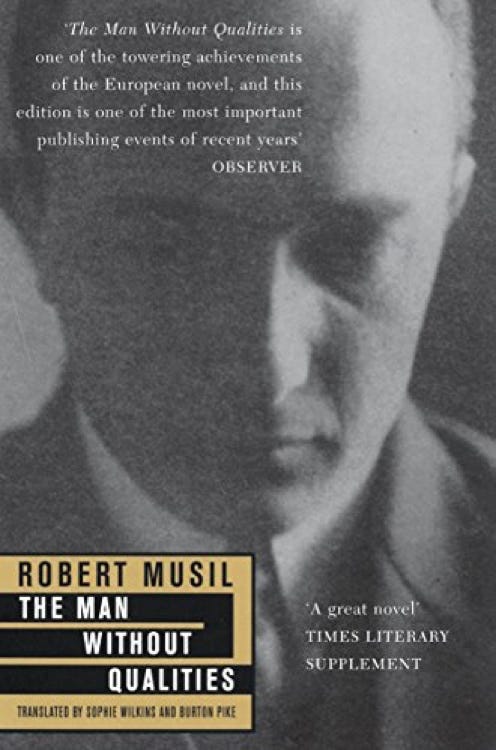
Title aside, Robert Musil’s The Man Without Qualities reads less like a conventional novel than like an atlas: layered plates, shifting scales, and a patient insistence on measuring the contours of a changing world.Published in installments between the 1920s and 1930s and left unfinished at musil’s death, the book refuses tidy narrative coordinates; instead it explores identity as a topography of provisional alliances, philosophical detours, and social currents. Its protagonist, Ulrich, is less a single point on a map than a roaming surveyor—observant, detached, constantly recalibrating his bearings amid the disintegrating compass of late Austro-Hungarian Vienna.This review approaches mapping Modern Identity as both a reading and a re-mapping: I trace how Musil’s formal experiments—digressive essays,tonal shifts,and elliptical scenes—function as cartographic techniques for representing the self in modernity. Rather than offering verdicts, the aim here is descriptive and interpretive: to show how the novel charts uncertainties of character, ethics, and belonging, and to consider what those maps reveal (and obscure) about the era that produced them and the readership that continues to study them. In doing so I will attend to the novel’s past coordinates, its narrative instruments, and the ways in which its unfinished edges invite readers to join in the cartography of identity.
Cartography of the Self Mapping inner division and social satire as musil charts psychological terrain in a sprawling modernist urban epic

Musil treats the city not merely as setting but as a living chart where inner contradictions become topography: loneliness curves into boulevards, hesitation nests in alleys, and the protagonist’s quiet analytic gaze traces fault lines beneath polite facades.In this mapping, identity is a pilgrimage across neighborhoods of doubt and possibility, and the novel’s voice deploys both clinical observation and sly mockery to translate feeling into geography. Fragmentation, irony, and
Social satire in Musil functions like a foil for psychological cartography: the public rituals and bureaucratic plateaus he mocks become reference points against which private unrest is measured.the result is an urban epic that together sketches a society’s absurdities and reveals the fissures of the self. Below is a compact guide to how inner states and social forms mirror one another in the narrative:
Best-Selling Books in This Category


- Ambivalence → ritualized politeness and administrative inertia
- Self-questioning → salons, speeches, and the theater of reputation
- Detached analysis → the cold geometry of institutions
| Inner Compass | social Map |
|---|---|
| Ambivalence | bureaucratic plateau |
| Curiosity | Salon conversation |
| analytic distance | Public spectacle |
Narrative as Survey A careful look at Musil s elliptical pacing experimental digressions and how form reflects crisis of conscience and era
Musil’s prose behaves less like a linear story and more like a cartographer’s notebook: pauses, sideways glances and intentional omissions map an inner topography rather than a plot. The effect is an almost scientific detachment — an observational mode that turns character into field notes and morality into hypothesis. These elliptical rhythms are not stylistic vagaries but instruments of inquiry: they refuse tidy resolution and instead stage a persistent,curious surveying of conscience. Digressions function as experiments, each one isolating a variable of personality or society so the reader can see the underlying mechanics of modern identity:
- Suspended sentences that create ethical limbo and force reflection
- Prolonged thought-experiments which test ideal types against lived ambiguity
- Neutral narration that mirrors a crisis of judgment rather than prescribing answers
| Formal device | Immediate effect |
|---|---|
| Elliptical pacing | Atmosphere of indecision |
| Digressive chapters | Intellectual deepening |
| Detached focalization | Moral ambiguity |
In this architecture of thought, form and era are inseparable: the novel’s methodical detours capture a society in technical flux and ethical drift, producing a literary mirror that insists readers examine themselves as much as the age it depicts.
Character atlas Interpreting Ulrich and representative figures as cartographic points of ambivalence moral inquiry and social observation in the novel
Ulrich reads like a longitude line threading Vienna: a cool axis of observation whose very stillness maps the novel’s moral fog.His introspections act like cartographic gridlines—precise, neutral, and insistently ambivalent—registering the dislocation between what society projects and what an inner compass can actually hold. In place of decisive peaks or valleys, Musil sketches gradients of uncertainty; the reader follows subtle contours where values blur into social coordinates. This is not a portrait of a man with clear qualities but a topography of hesitation, in which every ethical query becomes a landscape to be surveyed rather than a territory to be conquered.
- Ulrich — a meridian of doubt, mapping thought rather than action.
- Agathe — an island of idealized possibility, seen more as a point on a map than a person.
- Arnheim — economic contour lines, measuring influence and taste.
- Diotima — social latitude,shifting with each conversation and salon.
| Character | Compass Point |
|---|---|
| Ulrich | North of Certainty |
| Agathe | East of Ideal |
| Arnheim | West of Influence |
Reading these figures as cartographic points emphasizes the novel’s commitment to observation over verdict. The moral inquiries Musil stages are less about prescribing directions and more about tracing the pressure systems that shape behavior—social weather rather than ethical commandment. The result is a humane map of modern identity: one that resists neat legends, celebrates ambiguity, and invites the reader to keep charting the shifting lines between conscience and circumstance.
Philosophical Topography Tracing Musil s essays of possibility uncertainty and ethics woven into narrative layers that resist simple allegory
In Musil’s layered world the self is less a solid object than a shifting landscape of hypotheses: possibility becomes topography, and doubt is the contour line that refuses to settle into a single moral slope. The prose continually stages small ethical experiments — thought-situations that illuminate how decisions look from multiple altitudes — so that meaning is not handed down as allegory but politely declines to be pinned. Consider how scenes function like waypoints:
- Fleeting vantage points: characters offer provisional maps rather than final answers.
- moral hypothesis: actions suggest possibilities rather than punishments or rewards.
- Layered irony: narrative tone resists a single, stabilizing voice.
Reading becomes an act of cartography — the reader stitches together ethical contours from narrative fragments,testing bearings against uncertainty and recognizing that identity is frequently enough a byproduct of the route taken rather than a destination. Practical strategies that emerge from this reading practice include patient attention to ambiguity and a willingness to hold multiple, even conflicting, explanations in tension:
- Map the scenes: mark recurring motifs and see where they shift meanings.
- Trace hypotheses: treat characters’ judgments as experiments, not doctrines.
- Embrace undecidability: allow unresolved questions to reveal ethical depth.
| Coordinate | Effect |
|---|---|
| Ambiguity | Invites ethical imagination |
| Hypothesis | Transforms judgment into inquiry |
| Irony | Prevents simple allegory |
Historical Context Map Reading the Habsburg setting cultural stagnation and modernist ferment that shape the novel s sociopolitical horizon and tone
In Musil’s landscape the empire reads like a finely detailed map whose compass has lost true north: ceremonial forms remain intact while thier meaning dissipates, producing a cultural topography of polite inertia punctuated by sudden intellectual convulsions.The novel stages this paradox by tracing social rituals, administrative labyrinths and the airy conferences of intellectuals, each acting as cartographic markers that locate individuals between inherited roles and nascent self-fashioning. Within this crowded map three recurring pressures shape behavior and tone:
- Bureaucratic ritual — the slow machinery of an empire that measures time in protocol.
- salon and sociability — spaces where appearance negotiates reality.
- Modernist inquiry — scientific and philosophical experiments that unsettle certainties.
These forces create a sociopolitical horizon that is neither fully collapsed nor freshly born, producing Musil’s characteristic ambivalence: humor that spares no one, irony that reveals structural absurdities, and a tone that hovers between forensic precision and lyrical doubt. To read the novel is to consult a legend of signs — a small key that helps decode attitudes,institutions and moods rather than tidy causes. Consider this compact guide to recurring symbolic axes:
| Axis | Symbol |
|---|---|
| Administration | Clockwork |
| Social Performance | Mirror |
| Intellectual Modernity | Wire |
The result is a novelous cartography where identity is less a point on the map than a route — a continual negotiation between inherited contours and the restless searching that defines modern subjectivity.
Stylistic Compass Assessing Musil s prolonged sentences tonal shifts use of irony and the balance of wit and gravity across narrative panoramas
Musil’s sentences unfurl like carefully calibrated breathing: long, sinuous lines that accumulate detail until meaning arrives as a slow revelation. This sustained syntax does more than ornament; it functions as a tonal scaffold, carrying philosophical digressions, social observations and intimate aside in one continuous current. The effect is both mesmerizing and demanding—readers are invited into a rythm where reflection and momentum coexist, and where pauses and qualifiers become expressive instruments rather than mere punctuation.
- Cumulative cadence that accrues thought instead of resolving it quickly
- tonal pivots that reframe scenes without abrupt rupture
- Philosophical asides embedded within social panorama
- Granular observation that turns description into argument
Across the novel’s wide vistas Musil balances irony and seriousness with a near-musical touch: a quiet joke may undercut a profound insight, or a sober analysis slide into mordant wit. That balance is never careless; irony functions as both lamp and mirror—illuminating character foibles while reflecting the era’s uncertainties. The result is a tonal architecture where wit sharpens gravity and gravity lends weight to wit, producing an aesthetic that is at once cerebral, humane, and eerily modern.
- Irony as critique—softens judgment while exposing contradictions
- Witty gravity—humor that deepens moral and philosophical stakes
| Register | Effect |
|---|---|
| Deadpan irony | Exposes social absurdity |
| Lyrical introspection | Elicits empathy and depth |
| Abrupt tonal shift | Creates cognitive dissonance |
Reading Strategies Practical recommendations for readers and students on pacing translation choices thematic focus and engaging with the unfinished edges
Treat Musil like a map that demands a measured pace: slow down in the long, reflective sentences and allow digressions to open new routes rather than detours to skip. break the book into thematic ”stretches”—politics,interiority,irony—and assign each stretch a reading session so you alternate panoramic reading with close inspection. useful habits include:
- Chunking: fifty pages of steady advance, then a close-reading hour of five pages.
- Marginalia: mark recurring images (mirrors, clocks) and note where they reappear.
- Dialog aloud: read key exchanges to hear tonal shifts and comedic timing.
- Reading pairs: swap paragraphs with a partner to test interpretations.
These small rituals make the novel’s density navigable and keep interpretation anchored without flattening its complexity.
Translation choices and the novel’s incompletion call for experimental engagement: accept lacunae as interpretive invitations rather than flaws, and let contrasting renderings illuminate different facets. When selecting a version, favor editions with footnotes and introductions that explain textual history; when in doubt, consult two translations and treat the differences as critical data. Practical moves:
- Compare passages: pick a pivotal paragraph and read it in two versions to see shifts in tone.
- Create a ”translation log”: note words that recur with variable translations (e.g., “qualities,” “attributes”).
- Embrace the unfinished: mark gaps and craft tentative theses that account for ambiguity.
| Edition Type | Strength | Best Use |
|---|---|---|
| Annotated | Context and notes | Seminar work |
| Readable | Smooth prose | first pass |
| Scholarly | Variants, apparatus | Research |
By combining paced reading habits with comparative translation work and a tolerance for open endings, readers and students can turn Musil’s unfinished edges into productive ground for thinking about modern identity.
Comparative Cartography Suggestions for comparing Musil with Joyce Proust and Mann to illuminate modernist preoccupations and differing narrative approaches
Reading Musil alongside Joyce, Proust and Mann turns literary geography into a diagnostic tool: each author sketches the modern self from a different cartographic stance. Joyce fractures language and chronology into topographies of consciousness; Proust excavates memory’s sedimentary layers; Mann maps moral dilemmas across social panoramas; while Musil drafts an atlas of possibility—hypotheses, ironies and the stubborn ambiguity of identity. Consider these focal contrasts as swift reference points:
- Joyce: linguistic terrain, micro-topographies of thought
- Proust: temporal strata, memory as landscape
- Mann: ethical contours, social climate and temperature
- Musil: probabilistic maps, the uncertain regions between fact and idea
| Author | Dominant Tool | Cartographic Effect |
|---|---|---|
| Joyce | Stream & code | Dense, kaleidoscopic city-grid |
| Proust | Memory & detail | Slow, layered topography |
| mann | Argument & satire | Panoramic moral map |
| Musil | Analysis & indeterminacy | Speculative, open atlas |
To translate these observations into a usable comparative cartography, focus less on tidy correspondences and more on overlapping patterns: how do language, time, ethics and selfhood redraw boundaries when displaced from one writer’s map to another’s? Useful gestures include close-reading for recurring motifs, plotting narrative rhythm against psychological distance, and tracing how each novelist negotiates the gap between interior and exterior worlds. Try mapping exercises such as:
- Motif overlays — superimpose sensory images (odor, sound, light) to see shared axes
- Temporal slices — extract scenes and arrange them by pace to compare temporal logic
- Voice-distance grid — chart narrator proximity to central consciousness
These moves reveal not onyl common modernist preoccupations—alienation, memory, moral complexity—but also how divergent narrative techniques make each author’s cartography a different instrument for measuring the same human anxieties, with Musil’s map remaining provocatively provisional.
Visualizing Themes Design ideas for AI image prompts centered on motifs architecture mirrors maps urban salons and the fragmented human figure in Musil s world
Cityscapes are turned into inner landscapes where staircases and façades become memory-machines; imagine a skyline folded like a map, streets drawing constellations of decisions, and windows acting as mirrors that reflect not faces but possibilities. Scenes evoke the hush of an urban salon—a parlor of arguments, gestures and waiting—while architectural geometry cuts the human figure into planes and apertures, producing a portrait that is part portrait, part diagram. Prompting an AI to render these tensions means asking for controlled contradictions: rigid perspective with soft,diffuse psychology; latticework of corridors and conversations; fractured silhouettes that remain eloquent rather than merely dismembered.
Use concise visual templates to translate those tensions into images:
- Architecture as psyche: a baroque façade unfolding like a book, corridors annotated with handwritten maps.
- Mirror-portrait: a face fragmented across multiple reflective panes, each shard offering a different expression.
- Salon tableau: a smoky parlor at dusk where gestures are exaggerated and maps lie open on the table.
| motif | Quick prompt seed |
|---|---|
| Maps | folded city-grid, ink routes, soft light |
| Mirrors | fragmented reflections, warm glass tones |
| fragmented figure | overlayed silhouettes, architectural cutaways |
About the Author Robert Musil s intellectual biography artistic tensions and legacy as a modernist thinker who mapped uncertainty in twentieth century Europe
At the heart of a restless intellectual life,Robert Musil emerges less as a biographical portrait than as a cartographer of doubt: an engineer’s precision paired with a philosopher’s appetite for paradox. His notebooks and essays thread through Vienna’s salons and the ruins of empires, tracing a practice that constantly interrogated what it means to be modern.Key inflections of his thought can be sketched as quick compass points that orient readers toward the novel’s dense interior:
- Epistemic ambiguity — knowledge as unstable ground
- Formal experiment — narrative as diagnostic instrument
- Ethical observation — character as social probe
His legacy is not a tidy ledger but a set of tools for reading a century of transitions: a lexicon for uncertainty that modernists, critics and novelists still consult when mapping identity amid dislocation.Contemporary scholarship frequently enough treats Musil as a precursor rather than an outlier — a writer whose skepticism functions as method, whose prose is both mirror and scalpel. The traces he left ripple through later thought:
| Aspect | Echoes |
|---|---|
| Ideology | Critical theory, essays on method |
| Narrative | Fragmentation, experimental realism |
In Musil’s hands, the uncertain becomes a lens: not merely confusion to be resolved, but a productive condition that keeps questions open and criticism alive.
musil’s sprawling atlas of uncertainties leaves the reader less with conclusions than with coordinates: traces of a self in motion, a society in question, and questions that outlast tidy answers. The Man Without Qualities resists tidy summarization,and that resistance is its point — a careful invitation to dwell in ambiguity rather than to pin it down. Whether you come seeking philosophical clarity, historical panorama, or psychological portrait, you will find passages that illuminate and stretches that confound in equal measure. For those willing to negotiate its length and density, the reward is not closure but a richer sense of how modern identity is mapped and remapped. Read it as you would explore a city that keeps rearranging its streets: expect detours, keep your curiosity, and allow the book to alter the way you navigate your own map.