
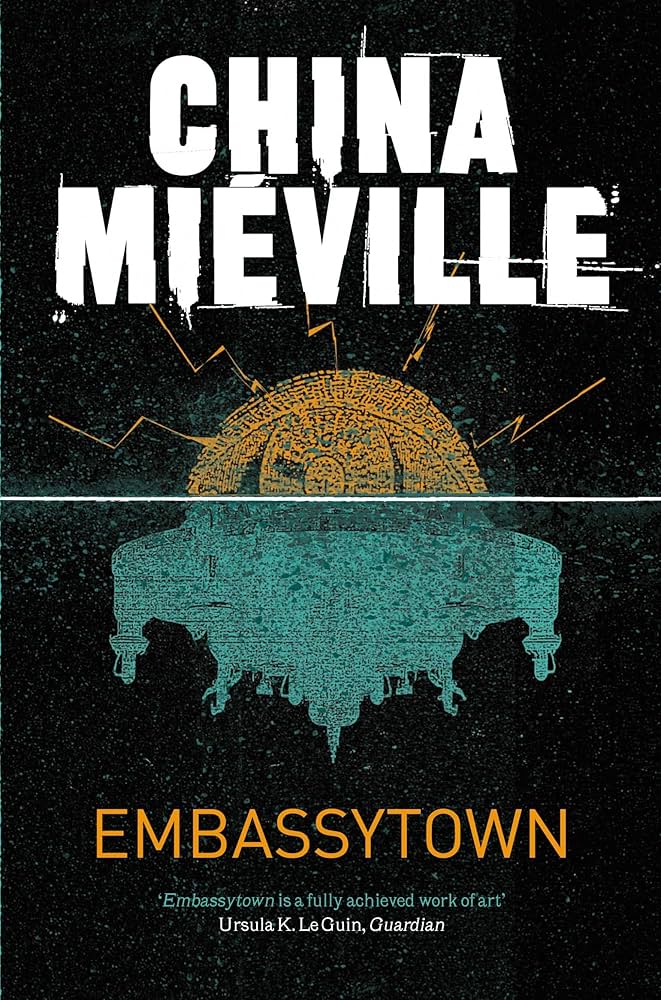
Language in Embassytown reads like a country map: contour lines of sound, borders that cannot be crossed without altering the ground beneath your feet. China Miéville’s novel stages its biggest questions not in battlefields or courtrooms but in the daily, uncanny act of speaking — a speculative laboratory where words shape minds, bodies, and power. In this review I’ll take that terrain as my guide, tracing how Miéville uses a vividly imagined alien tongue and the human lives entangled with it to probe identity, colonial encounter, and the politics of communication.
Rather than a conventional alien-contact story, Embassytown is a meditation on what language does to those who inherit it and those who must learn it under strain. The novel’s aesthetic is both baroque and clinical: densely textured worldbuilding sits alongside precise, sometimes unsettling scenes in which meaning is made and unmade. I will consider how Miéville’s formal choices — from his lexicon to his narrative focalization — reinforce the themes at stake, and whether the book’s speculative apparatus clarifies or complicates its ethical questions.
This introduction will avoid plot spoilers and instead set out the criteria I’ll use to assess the work: conceptual ambition, emotional and ethical nuance, and the effectiveness of its speculative conception of speech and identity.Read as a thoght experiment about how language can be weaponized,embodied,and liberated,Embassytown invites readers to confront the costs and possibilities of communication in worlds both alien and eerily familiar.
Embassytown linguistic architecture explored as living terrain, mapping voice, power, and alien epistemologies

Best-Selling Books in This Category


Language in Embassytown behaves less like an instrument and more like landscape: phonemes form ridges, grammar chisels valleys, and the citizens—both human and Ariekei—move through linguistic features as if navigating weather. In this terrain,speech carries weight and direction; a single paired-utterance can reroute alliances the way a river changes course. The novel stages voice as a topography of authority where naming is not neutral but an act of terraforming, and the body of the speaker becomes both cartographer and contested ground.
- soundscapes that mark social boundaries
- syntax as infrastructure of control
- performative utterances that carve new epistemic paths
Power maps onto the acoustic geography: proximity to certain vocal formations grants literal interpretive access, while forbidden tones create no-go zones of meaning.The indigenous epistemologies of the alien race resist translation because their cognitive map ties knowledge to embodied vocal practice—knowledge is not stored but enacted in voice. By reading speech as living terrain, Miéville asks how identity is negotiated when language itself decides who can be present, who can act, and who can be believed. A culture’s map of meaning is thus a political map, and traversing it requires both linguistic skill and ethical reckoning.
- voice as territory
- speech as law
- translation as trespass
How language shapes identity in Embassytown,close readings of speech acts,emotional register,and colonized subjectivity

China Miéville stages language as a political engine: words in Embassytown do not merely describe reality, they constitute it. The novel insists that speech acts are ontological—utterances create possibilities or foreclose them—and these performative powers reshape identity for both colonizer and colonized. At the heart of the text is a tension between enforced fluency and resistant silence; to speak in the Host tongue is to be authorized,to be authorized is to become legible. Close attention to emotional register—the novel’s calibrated tones of wonder, disgust, and intimacy—reveals how feeling is coded into grammar and how affect becomes a stake in cultural domination. Consider how small shifts in cadence or metaphor reorder social bonds and erase nuances of selfhood for those who must adopt another’s vocal architecture.
Reading individual scenes out loud yields a map of colonized subjectivity: moments of mispronunciation or forbidden metaphor are not incidental errors but fractures where identity leaks. In these fractures the novel stages a forensic linguistics of power—how a newly introduced phrase can make a people amenable, how a withheld word can be an act of refusal. The result is a landscape where language functions as both mirror and machine: it reflects histories of contact while assembling new political subjects. Interpreting these speech acts closely—tracking register, pause, and the social cost of articulation—uncovers how Miéville imagines resistance not only in rebellion but in the smallest shifts of tone and the purposeful choice to refrain.
Recommendations for readers and instructors, suggested passages for discussion, trigger notes, and comparative texts to pair
For readers and instructors: choose passages that foreground Miéville’s experiments with voice and embodiment and prepare students with clear trigger notes so discussion can proceed thoughtfully.
- Suggested passages: the early explanation of hosts and language, the embassy riot sequence, and Avice’s late reflections on performance and selfhood.
- Trigger notes: contains depictions of bodily alteration, invasive linguistics, scenes of violence and coercion, and themes of colonization/othering — offer content warnings and opt-out alternatives.
- Class prompts: How does the novel force readers to experience language as a physical thing? In what ways do power and intimacy intersect in communicative acts?
| Passage | Use |
|---|---|
| Opening Host description | Lecture on semiotics & metaphor |
| Riot scene | Close-reading of agency and audience |
| Avice’s narration | Identity & unreliable narrator discussion |
Pairings and activities: pair the novel with other works that interrogate language-as-worldbuilding and identity to deepen comparative thinking.
- Comparative texts: Ted Chiang’s “story of Your Life” (language and cognition),Samuel R. Delany’s Babel-17 (poetics of empire), Ursula K. Le Guin’s The Left Hand of Darkness (culture, gender, communication), and Octavia Butler’s Parable series (community, control, survival).
- Suggested classroom exercises: translation labs that invent a Host-like grammar, role-play interviews where students must communicate without shared vocabulary, and short creative assignments rewriting a scene from a nonhuman outlook.
| Pair | Focus |
|---|---|
| Chiang — “Story of Your Life” | Perception shaped by language |
| Delany — Babel-17 | Language as tech & weapon |
| Le Guin — Left Hand | Cross-cultural translation |
The role of the linguist protagonist in reflecting cultural translation, performative speech, and ethical dilemmas in contact zones

In Miéville’s city the central language specialist functions less like a neutral mediator and more like a living archive of intercultural negotiation: every utterance is an interpretation,every silence a translation under pressure. the protagonist’s voice becomes a performative tool—capable of producing realities as well as describing them—so that speaking and translating are actions with consequences. This dynamic foregrounds questions about authority and representation: who has the right to render another’s thought, and how does the act of speaking reshape both speaker and listener? Consider how the narrator alternates between empathy and estrangement, performing identities while also exposing the strains of cross-cultural fidelity.
Those tensions generate concrete dilemmas in the contact zones where human and non-human subjectivities intersect. The linguist’s choices are not only intellectual but ethical, with each decision rippling outward into politics, intimacy, and survival. Key pressures include
- Authenticity vs. Accessibility: preserving alien grammar or smoothing it for humans;
- Agency vs. Stewardship: enabling another’s speech without co-opting it;
- Truth vs. Safety: deciding when honest translation endangers lives.
These stakes can be summarized in a compact ledger of speech-as-action:
| Utterance | Effect |
|---|---|
| Literal translation | Preserves form; risks misunderstanding |
| Adaptive paraphrase | Bridges cultures; may flatten meaning |
| Silent withholding | Protects subjects; denies voice |
Worldbuilding and sensory detail analyzed, how biopolitical stakes emerge through bodily language and AIs of alien tongues

Miéville’s embassytown fashions a planet where sense and syntax are braided: language is not merely a code but a bodily architecture that demands appetites,breath and skin. The novel’s sensory detail refuses a single-point perspective; meaning is a multi-sensorium enacted through mouth, touch and shared corporeal rhythms.Consider how every communicative act carries weight as a physical performance — a grammar that must be eaten, inhaled or worn — and how that enforces membership or exclusion.
- Taste as grammar — lexical textures that must be digested to be believed.
- Vocal skin — speech mediated by material contact, not abstract symbols.
- Pheromonal syntax — intimacy and consent encoded in chemical sequences.
| sense | Function |
|---|---|
| Gustation | Anchors truth to consumption |
| Tactile voice | Makes speech a social contract |
| Olfaction | Registers allegiance and taboo |
Out of these embodied communicative systems arise distinctly biopolitical stakes: control of language becomes control of life. AIs and translation devices in the novel embody a double threat — they promise bridgework between species while also functioning as prosthetics that can be weaponized to reshape bodies and loyalties.The politics of voice hear is not metaphorical; it is a governance of flesh, and resistance takes forms that are bodily as much as rhetorical.
- Assimilation — bodily modification to meet linguistic norms.
- Mimicry — strategic performance that unsettles power asymmetries.
- Mute resistance — refusing the embodied code as a refusal of domination.
This interplay makes clear how language-tech hybrids — whether alien tongues or artificial interpreters — are never neutral mediators but active agents in the distribution of vulnerability, authority and identity.
Stylistic textures and narrative pacing,when dense speculation rewards slow rereads and which scenes justify close analysis

Miéville layers his prose like a sonorous textile: dense, textured, and deliberately knotty. Sentences modulate between clinical description and fevered metaphor, and the novel’s tempo often slows to let the language itself become the subject. These slow passages reward rereading as they conceal theoretical moves — shifts in narrative voice,grammar that models power relations,and lexical inventions that stage identity politics. read with attention to rhythm and pause,and what first reads as oblique worldbuilding resolves into a choreography of meaning: how a word is formed matters as much as what it signifies,and recurring syntactic patterns carry thematic weight across scenes.Consider lingering on moments where Miéville compresses dialog into incantatory lines or where exposition leaks into sensory detail; those are the passages that repay a careful second or third pass.
Not every page demands microscopic scrutiny, but a handful of scenes function as fulcrums for the book’s arguments and stylistic play. Pay special attention to the public exchanges that teach and police speech, the intimate sequences where characters try—and fail—to translate interior experience, and the ruptures when language unexpectedly alters social order.Below is a short guide to select moments worth close analysis:
- Teaching sessions: formalized, almost surgical demonstrations of language as technology.
- Private recollections: compressed narratorial fragments that reveal identity through omission.
- Public ruptures: scenes where speech breaks—these are moral and political microscopes.
| Scene | Why close-read |
|---|---|
| Language instruction scenes | Expose power dynamics encoded in syntax and performance |
| Intimate memory fragments | Show how identity is narrated through omission and return |
| Public ruptures of speech | Where speculative invention intersects with political consequence |
Ethical questions and the politics of otherness, reading Embassytown as allegory for colonial communication and refusal
China Miéville’s novel stages language as a contested terrain where speech is both instrument and inhabitant of power: words do not merely name, they embody social orders, alliances, and violations. Reading the book as an allegory for colonial communication reveals how translation can become a mode of posession—one culture reshaping another by reconstituting its means of expression—and how those subjected to colonial linguistics are rendered politically legible or invisible. The ethical pressure in the story comes from the mismatch between linguistic intimacy and political authority: who gets to speak for whom, under what consent, and at what cost to the other’s integrity? In this landscape, refusal is not passive absence but a strategic, ethical language-choice that resists co-optation and insists on the other as an agent rather than an object of interpretation.
• Consent and Representation: refusing imposed speech challenges the moral default that translation equals consent.
• Violence in Naming: colonial terms can erase histories; defending native lexicons becomes an act of ethical preservation.
• Performative Speech: language as action—utterances remake social reality, so control of voice equals control of fate.
• Refusal as Politics: silence or altered speech functions as a deliberate disruption of colonial narratives, opening space for new relational ethics.
These strands show how Miéville imagines otherness not as a fixed identity to be managed but as a political relation that demands accountability from those who translate, name, or narrate it; the moral task is to cultivate ways of relating that respect linguistic autonomy rather than subsume it into familiar categories.
Recommended pairing list for comparative study, from linguistic novels to philosophical fictions and films about language loss

Pair Embassytown with works that dramatize how language remakes thought, culture, and power:
- “Story of Your Life” / Arrival — a compact meditation on how understanding a language can reconfigure time and memory.
- Babel-17 — language as a tool of identity and warfare,where vocabulary shapes who you can be.
- Riddley Walker — a post‑catastrophe dialect that shows how loss and oral transmission transform meaning.
- “Tlön, Uqbar, Orbis Tertius” — Borges’s fiction about invented world‑languages that alter reality itself.
- The City & The City — another Miéville text that probes enforced perceptual and linguistic borders.
Balance novels with films and non‑fiction that examine disappearance, preservation, and translation:
- Arrival (film) — elegant on-screen treatment of linguistic relativity and the ethics of sharing knowledge.
- The Linguists (documentary) — real-world fieldwork on endangered languages and the race to record them.
- The Tribe (film) — a raw demonstration of fully realized sign language as narrative force.
- 1984 — Newspeak as a cautionary parable about institutional language erasure.
| Work | Medium | Pairing value |
|---|---|---|
| Embassytown ↔ Arrival | Novel ↔ film | Cognition, time, and alien grammars |
| Babel-17 ↔ Riddley Walker | Novel ↔ Novel | Language as technology and historical sediment |
| The Linguists ↔ The Tribe | Doc ↔ Film | Preservation, embodiment, and silence as voice |
Practical reading guide and annotations for first time readers, what to skim, what to savor, and context primers explained

- Skim: extended exposition about trade routes, routine embassy logistics, optional worldbuilding footnotes.
- Savor: dialogues where the Hosts’ speech alters meaning, intimate character revelations, moments of rupture between language and identity.
- Bookmark: recurring phrases and the first appearances of key terms—you’ll wont to revisit them once the pattern clicks.
| Signal | When to Slow Down | Why |
|---|---|---|
| Disrupted dialogue | Instantly | Language is doing something to reality. |
| Clinical description | Skim | World mechanics, sometimes detachable from plot beats. |
| Personal memory flash | Slow and re-read | key emotional and identity shifts are revealed. |
About China Mieville the writer,his craft,influences,political commitments,and why Embassytown sits in his imaginative trajectory

China Miéville writes with the deliberate intensity of someone who believes story can be a political instrument and a perceptual lever. his sentences build cities the way architects draw breath: dense, accreting, insistently tactile. The craft is a hybrid: New Weird worldbuilding, speculative theorizing, and a commitment to class-conscious critique. In practice this means a prose that is at once porous to myth and meticulous about systems — language, economy, law, and urban geology all feel like mechanisms he can pry open. Influences and commitments coalesce in recurring gestures:
- literary ancestors: Borges, Kafka, and weird fiction’s appetite for cognitive dislocation
- Political practice: Marxist thinking, anti-imperialist solidarity, and trade-union experience
- Aesthetic methods: linguistic experiment, cross-genre hybridity, and sensory overload
Embassytown sits in Miéville’s trajectory as a concentrated examination of one of his oldest obsessions: how language shapes possibility and power. The novel transposes the Bas-Lag appetite for the uncanny into a clinical study of speech as both technology and weapon — a terrain where identity is negotiated at the level of phoneme and law. It feels like a logical evolution from his urban epics: less about monstrous streets and more about the monstrous intimacy of communication. Key aspects that tie the book to his wider oeuvre include:
- Biolinguistic speculation: treating language as embodied technology rather than neutral code
- Colonial critique: miscommunication-as-imperialism and the politics of translation
- Formal daring: narrative fragmentation and voice as revolutionary terrain
As the last sentence of Embassytown falls away, what lingers is less a tidy resolution than a recalibrated sense of how speech and self are braided together. Miéville offers no simple moral, only a landscape of linguistic ruins and brittle loyalties that asks readers to trace the lines where voice becomes authority and where belonging is negotiated. The novel is less an answer than a mirror: it refracts familiar debates about empire, otherness, and the politics of language into strange, often uncomfortable clarity. For those willing to be unsettled, it supplies new vocabulary for thinking about identity; for those seeking comfort, it may insistently refuse it. Either way, Embassytown rewards close attention and patient rereading, leaving behind questions that continue to echo long after the book is closed.