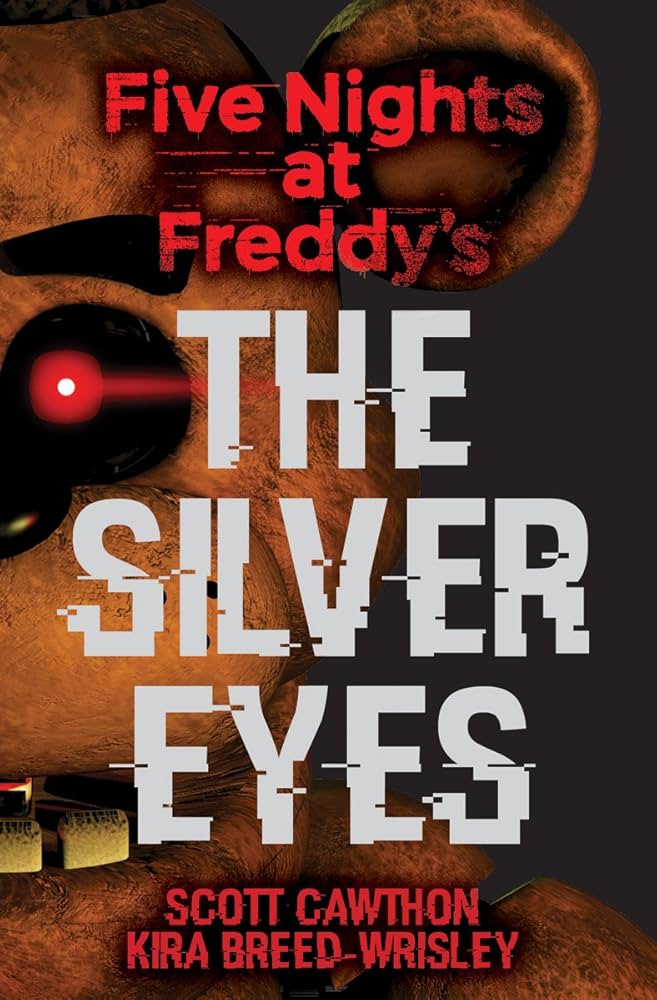
A children’s birthday party frozen in a smear of stale confetti and humming animatronics: that is the image The silver Eyes invites you to step back into, only to realize the toy-like smiles are watchful and the melodies have teeth. Scott Cawthon’s novel—co-written with Kira Breed-Wrisley and born from the unsettling world of the five Nights at freddy’s games—recasts pixelated jump scares into a page-turning strain of haunted nostalgia.It trades sudden jolts for a slow-burn unease, asking whether the past we remember as comforting might rather be the source of something far more sinister.
This review will trace how The Silver Eyes balances its three central impulses—nostalgia, fear, and mystery—looking at how atmosphere, characterization, and pacing either amplify or undercut the book’s ambitions. I’ll avoid major spoilers while assessing whether Cawthon’s transition from game designer to novelist succeeds in giving fans and newcomers alike a story that is eerie, emotionally resonant, and narratively coherent.
Opening the rusty doors of nostalgia and dread an overview of tone atmosphere and the emotional pull of The Silver Eyes
Behind the rusted hinges the tale breathes in a way that makes the familiar feel foreign: nostalgia is worn and fraying, and dread slips thru the seams. Scott Cawthon sculpts an atmosphere where childhood relics—balloons, paper crowns, the echo of a birthday song—are refracted through clinical metal and dim stage lights, so every warm memory carries a cold reflection. the setting becomes a character, a liminal room where the past presses against the present and the air tastes of old frosting and motor oil.
Best-Selling Books in This Category


- Flickering lights — memory stuttering into menace
- Faded mascots — innocence hollowed into enigma
- Creaking stages — time moving with a mechanical patience
- Empty eyes — mirrors that refuse to show comfort
The emotional pull arrives as a measured tug between consolation and unease: moments of genuine empathy are counterbalanced by revelations that reopen old wounds. Readers are invited to inhabit both grief and curiosity—feeling protective toward characters while simultaneously inching toward the unknown—and that push-and-pull delivers a slow, insistent haunting rather than an outright scream. In that tension the novel finds its voice,soft and uncompromising,coaxing reflection long after the last page is turned.
| Cue | Effect |
|---|---|
| Faded birthday cake | Pang of loss |
| Whirring animatronics | Primal unease |
| Old photographs | Anchored nostalgia |
How nostalgia shapes fear analyzing familiar childhood settings mechanical mascots and the unsettling shift from comfort to menace in the story

Memory acts like a dimmer switch in Scott Cawthon’s world, lowering the lights on playground laughter until outlines blur and shadows sharpen. Those same mall corridors and birthday rooms that once promised cake and friends become stages for a different kind of attention: the slow, watchful presence of mechanical mascots. The book exploits the strange overlap between the domestic and the manufactured — the way a painted smile on a familiar mascot can,in the wrong light,read as a intentional hush. Nostalgia here is not simply fondness; it is a lens that both softens and reveals, turning childhood comfort into a map of omissions, loud with the silence of things we forgot to question.
That inversion — comfort into menace — is driven by tiny sensory flips that make the ordinary feel wrong: a cheerful jingle stretched into a looped drone, the sticky scent of soda turning sour, the hollow halo of stage lights exposing seams. The narrative leans on these microbetrayals to unsettle the reader, showing how the past’s warmth can shelter a colder truth.Consider how everyday cues are repurposed in the story:
- Bright balloons → faded, dusty decorations
- happy songs → warped, repeating jingles
- Amiable eyes → glassy, immobile lenses
- Hands that handed out prizes → gears that trap and grip
- Familiar routes → corridors that loop back to secrets
| Comfort cue | Menacing counterpart |
|---|---|
| Birthday cake | Stale confetti |
| Soft lullaby | Endless mechanical jingle |
| Friendly staff | Unblinking animatronic gaze |
Characters under the mask the human stories behind the animatronics and the ways guilt grief and memory drive the mystery forward
There is a persistent ache beneath the gears and fiberglass—an ordinary human residue of loss, wrong turns, and the small, stubborn details that refuse to stop hurting. The animatronics are not just set pieces; they are palimpsests of memories: a child’s birthday song stuck like a needle in a wound, a name whispered in the dark, a promise that curdled into silence. In that quiet friction the novel finds its true power, showing how guilt can animate a conscience as effectively as any motor, how grief wears a familiar face until it is unrecognizable, and how memory stitches discontinuous moments into a narrative that drives people back to places they swore they’d left behind.
These interior lives turn each mechanical twitch into testimony, and the investigation becomes as much about assembling fractured recollections as it is about assembling evidence. Small artifacts—photographs, a faded badge, the battered edge of a hand-drawn map—act as catalysts, and the characters’ emotional currents map neatly onto the plot’s revelations:
| character | Emotional Driver |
|---|---|
| Charlie | Memory—searching for what was lost |
| Mike | Guilt—haunted by apologies unsaid |
| John | Grief—protecting what remains |
Pacing tension and atmosphere weighing jump scares against slow burn dread and recommending which readers will relish this mood driven horror mystery

Scott Cawthon favors a slow, corrosive unraveling over cheap shocks: the novel’s power is in the way tension accumulates like dust settling behind amusement-park glass, until a single moment of recognition cuts through it.There are sudden jolts—a flicker of mechanical movement, a memory that snaps too sharp—but they function as punctuation, not the backbone. The atmosphere is sculpted through lingering sensory detail and the quiet dissonance of nostalgia gone wrong, so readers feel pursued by implication as much as by action. Key elements you’ll encounter include:
- Lingering dread that grows from setting and memory
- Occasional shocks that reframe what you already suspect
- character-driven suspense where questions matter more than screams
If you crave adrenaline-packed jump-scares and breathless pacing,this isn’t primarily for you—yet even jump-scare lovers will appreciate the few well-placed jolts that land with narrative weight. The book is best enjoyed by readers who relish mood-driven horror: those who love unpicking mysteries, savoring atmosphere, and letting slow-burn dread settle in their bones. Recommended readers:
- Mystery fans who like clues and revelations over continuous shocks
- Nostalgia readers intrigued by haunted memory and cultural artifacts
- Pacing connoisseurs who prefer creeping unease to non-stop action
| If you want | Expect |
|---|---|
| Slow-burn unease | Slow, satisfying dread |
| Nonstop scares | A few sharp, meaningful jolts |
World building and setting details mapping the abandoned pizzaplex the eerie props and the timeline clues that reward observant readers
The pizzaplex itself reads like a map of memory and menace: corridors that fold back on themselves, rooms lit by the jaundiced glow of arcade machines, and a service hatch perpetually smeared with the ghost of grease. Every object is a datum—a prop not just for scares but for stories—from the cracked prize counter to the limp party hat wedged behind a curtain. Observant readers feel the space as much as see it; the building’s architecture, the placement of mirrors and blind corners, and the layers of plaster peeled away reveal intentional choreography of dread. Embedded in the décor are small, unsettling details that pull attention if you look:
- Ticket crate with numbers scratched inside
- Stage curtain scorched along one edge
- Backstage nameplate taped over another
these shards of set dressing work like coordinates in an atlas — follow them and you can trace the ebb and flow of whatever broke the place open.
Scattered across that atlas are temporal breadcrumbs, each one a subtle invitation to piece together the past: a child’s crayon drawing dated in a corner, a cashier’s ledger with one page folded over, a broken clock forever stuck at 3:17. Readers who catalogue these clues get rewarded—the narrative yields layers instead of a single reveal—because time in the pizzaplex is not linear but accretive.Below is a compact key to the most telling hints and their plausible implications, a cheat-sheet for patient sleuths:
| Clue | Implication |
|---|---|
| Stopped clock (3:17) | Moment of collapse or emergency |
| Folded ledger page | Hasty evacuation / missing names |
| Crayon drawing dated ’98 | Earliest known visitor implicated |
Piece these together and the pizzaplex shifts from static set-piece into a living archive; the more careful your reading, the more the building will confess its history.
Narrative voice and structure assessing writing clarity character perspectives and where the novel borrows from interactive game lore without relying on it

The novel’s narrative voice favors clarity over gimmickry: sentences move with a calm, observant rhythm that puts people before puzzles. Scenes are mostly anchored to emotional perception rather than technical clarification, so the reader learns the world through memory, fear, and small domestic details rather than through exposition dumps.
| Element | Game Lore | Novel Treatment |
|---|---|---|
| Origin | Fragmented hints | Grounded backstory |
| Threat | Mechanics & jumps | Psychological weight |
| Atmosphere | Interactive dread | Quiet, slow-building tension |
That choice lets the book nod to the games—familiar names, ominous machines, a haunted venue—while still functioning as a self-contained mystery. Readers who never touched the source material will find enough context to follow, and long-time fans will recognize the lore reframed as human consequence rather of gameplay mechanics.
Character viewpoint is handled with deliberate economy: rather than flitting between every possible eye, the narrative lingers where the emotional stakes are highest, building sympathy and suspicion in tandem. The structure leans on short, revealing flashbacks and a steady present-tense investigation, which keeps the plot readable without flattening complexity. Key strengths include:
- Accessible exposition that explains the world without halting the story.
- Character-first scares—tension comes from relationships as much as from animatronics.
- Standalone worldbuilding so the novel borrows imagery and myth but doesn’t depend on prior gameplay.
These choices make the book feel like a translation of interactive lore into a novelistic register: familiar motifs are preserved, but their meaning is reshaped to serve mood and motive rather than mechanics.
Themes of childhood trauma and community unraveling exploring how secrets intergenerational pain and forgiveness shape the emotional core of the book

Memory in The silver Eyes is not a gentle film strip but a rusted music box that keeps winding on in the dark—childhood is both cradle and cage. Small-town smiles fray as buried details leak: a toy left under a bed becomes evidence, a whispered name becomes an accusation. The novel shows how secrets travel like quiet diseases through generations,turning parental silences into the brittle scripts children inherit. In the margins of the narrative you find recurring traces:
- forgotten rooms that hold stories
- murmured apologies that never landed
- objects that act as memory anchors
These elements make trauma communal—a contagion woven into block parties and backyard fences, so that the town’s unraveling feels inevitable and intimate at once.
Forgiveness in the book is neither instant nor neat; it arrives like weather, slowly altering the landscape. Characters face the arithmetic of repair: what can be returned, what must be carried forward, and which betrayals demand naming before healing is possible. The prose treats reconciliation as work rather than miracle, suggesting that intergenerational pain can be softened through attention, confession, and new rituals:
- storytelling that replaces silence
- ritual acts that mark accountability
- small mercies that restore trust incrementally
By threading forgiveness with fear and memory, the emotional core becomes a map of how communities break and, sometimes, how they learn to stitch themselves back together.
Horror mechanics and psychological unease distinguishing cheap shocks from lingering implications and advising which scenes may linger after reading
There is a craft to fear in The Silver Eyes that separates a fleeting jolt from something that crawls under your skin. Where cheap shocks announce themselves—loud noises,sudden reveals,obvious cliches—the book leans instead on suggestion: the slow accumulation of odd details,the weight of memories that don’t line up,and sensory cues that imply more than they show. These are the mechanics that create unease long after the page is closed: deliberate gaps in perspective, timing that lets dread swell, and the uncanny refusal to fully explain. Small, repeatable motifs do more heavy lifting than a single scream, such as
- a toy’s inexplicable presence in an empty room
- a child’s drawing that alters meaning on reread
- a familiar song playing out of sync with a memory
- a description of light that feels almost wrong
When deciding which moments will linger, favor scenes that reward creativity rather than those that resolve everything. Scenes that linger are those that leave a question lodged in the reader’s mind, or reframe an earlier memory when you think of it again. Look for quiet sequences where implication does the work—the slow reveal in a derelict kitchen, a single off-hand line of dialogue, or an ending that opens a door instead of slamming it shut. Keep these in mind while reading:
- the birthday party flashback that reappears with new context
- the dim backroom moment where machinery hums but nothing is shown
- a final image that reframes the protagonist’s reliability
- a short, eerie exchange that persists like a whisper
Accessibility and reader pathways suggesting companion reads content warnings and which editions or audiobooks best capture the tone and pacing
For readers who need or prefer alternative formats, The Silver Eyes is forgiving: adjustable e‑books let you increase font size and switch to dyslexia‑friendly fonts, while large‑print paperbacks preserve the tactile nostalgia of arcade tokens and ticket stubs. The audiobook route notably suits those chasing atmosphere—seek an unabridged single‑narrator edition with restrained pacing and minimal sound cues to best preserve the slow-burn dread; avoid heavily scored or full‑cast productions if you want to keep the tension intimate rather than cinematic. Below are speedy signposts to help you choose how to approach the book and what to flag for sensitive readers.
- Content warnings: death and body horror, implied mutilation, children in peril, grief and trauma, jump scares and claustrophobic sequences.
- Reader pathways: nostalgia-first (start with a hardcover/illustrated edition), fear-first (listen to the audiobook at dusk for pacing that amplifies suspense), mystery-first (read with an annotated or ebook version to follow clues closely).
- Companion reads: pick works that echo the blend of childhood wonder and menace—modern gothic, uncanny children’s tales, or media that balance slow-burn scares with wistful nostalgia.
If you want a quick cheat sheet for editions and their strengths,choose an illustrated paperback for the warm,retro feel that amplifies the novel’s nostalgic pulls; an unabridged audiobook with a measured narrator for pacing that lets dread creep in between lines; and an e‑book with dyslexic font or read‑aloud enabled for accessibility and annotation. Below is a simple guide to match format to experience so you can pick the pathway that best fits how you like to be unsettled.
| Format | Best for |
|---|---|
| Illustrated paperback | Nostalgia and atmosphere |
| unabridged audiobook | Pacing and intimate tension |
| E‑book (dyslexic font) | Accessibility and annotation |
| Collector’s hardcover | Display value and immersive nostalgia |
About the writer Scott Cawthon tracing his creative journey from independent game developer to novelist and how his background informs The Silver Eyes

what began in a small home studio with offbeat animations and humble indie experiments evolved into a singular voice that blends mechanical dread with suburban familiarity. Scott Cawthon’s trajectory—self-taught coder, animator, and designer—shaped a DIY storytelling approach: he learned to craft atmosphere with limited resources, to suggest horrors more than show them, and to let audiences fill in the blanks. These habits translated neatly to prose, where economy of detail and an ear for pacing create the same tension players felt in his games. His career taught him to lean on:
- world-building through implication
- rhythmic pacing that mimics gameplay loops
- character silhouettes that invite reader projection
all of which are audible in the creaks and silences of The Silver Eyes.
in the novel,those game-formed instincts become narrative techniques—fragmented timelines,mechanical specificity,and a community-aware voice—so that the book reads like a reconstructed memory of a haunted amusement: intimate,schematic,and quietly procedural. The book’s architecture mirrors his past work, folding jump-scare rhythm into chapter turns and animatronic minutiae into motif. A simple timeline below captures the arc from pixel experiments to published fiction, showing how each phase fed the next in service of that unique, uncanny register:
| Phase | Signature |
|---|---|
| Early indie work | Hands-on problem solving |
| FNAF breakout | Mass engagement, myth-making |
| The Silver Eyes | Expanded lore, novel craft |
The result is a novel that still feels interactive in spirit—rooted in the mechanics of play but remade into the texture of memory and mystery.
The Silver Eyes lingers like an old photograph touched by a shadow — familiar enough to stir a warm ache, strange enough to make you check the corners. Scott Cawthon stitches nostalgia and unease into a winding mystery that rarely lets you settle, leaving impressions of both childhood rooms and locked doors. Whether the book thrills with its atmosphere or frustrates with unanswered questions depends largely on what you bring to it: a hunger for scares, a fondness for the original mythos, or a taste for puzzles threaded through memory.
if you crave a story that balances sentiment with suspense, this novel will satisfy in fits and starts; if you prefer clean resolutions, it may leave you wanting. Either way, The Silver Eyes offers a curious, unsettling journey — one that invites readers to revisit the past, examine its shadows, and decide for themselves which parts to keep and which to leave behind.
Open the book, and let the lights flicker. The truth may not be comforting, but it will be unmistakably alive.