
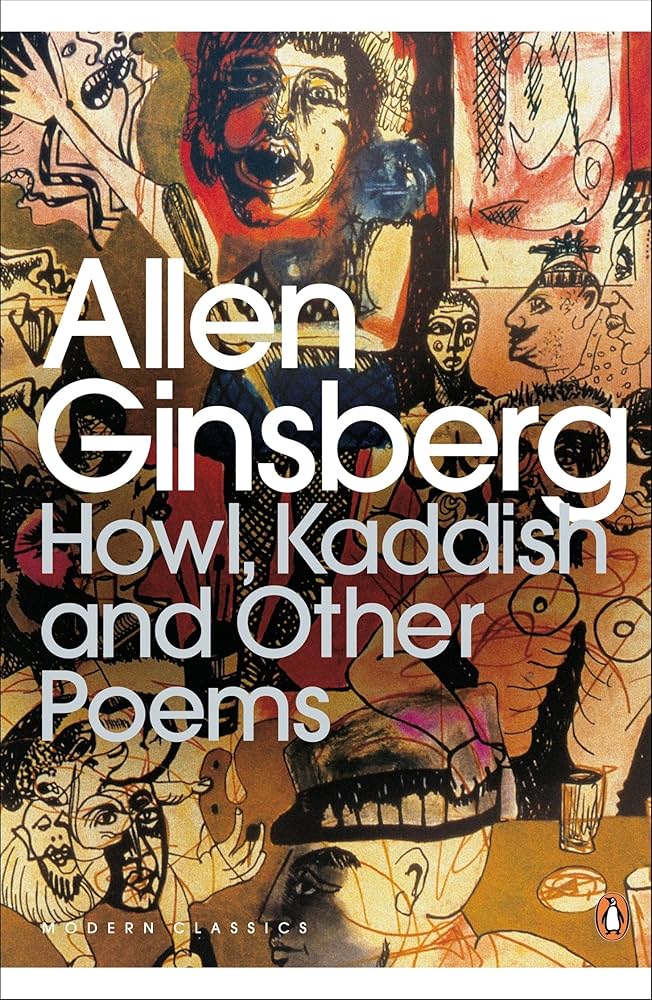
In the vast landscape of twentieth-century poetry, few works resonate with the raw intensity and cultural upheaval as profoundly as Allen Ginsberg’s Howl and Kaddish. These poems, emblematic of the Beat Generation’s restless spirit, continue to echo through the corridors of literary history, challenging readers to confront both the exhilaration and anguish of a turbulent era. embarks on a thoughtful exploration of these seminal texts, weaving together analysis and insight to illuminate the enduring power and complexity embedded within Ginsberg’s voice.This review invites readers to revisit the fragmented rhythms and haunting reflections that define Ginsberg’s legacy, offering a nuanced viewpoint on his contribution to poetry and cultural discourse.
The Raw Power of Howl Unveiled Through Vivid Imagery and Unfiltered Emotion

Allen Ginsberg’s howl emanates with an almost palpable intensity, its verses crashing like waves of unfiltered emotion against the shores of mid-20th century American conformity. Vivid imagery serves as the poem’s backbone, painting a sprawling, chaotic landscape that captures the despair and ecstasy of a generation caught in the throes of existential turmoil. From the stark, hallucinatory images of “angel-headed hipsters” to the visceral depictions of drug-fueled nights and mental institutions, the poem’s raw power dissects the human psyche without pretense or dilution. Ginsberg’s use of sprawling, breathless lines mirrors the breathlessness of a culture gasping for freedom, while his unrelenting honesty strips away societal facades to reveal the core madness and beauty of existence.
- Imagery as a mirror: Reflects the fractured soul of post-war America.
- Emotional cadence: Builds a rhythm of fury, love, and despair.
- Language as liberation: Breaks free from poetic conventions.
The emotional current running through Howl refuses to ebb, sweeping the reader into a tumultuous journey where vulnerability is both weapon and shield. Ginsberg’s honesty strips away layers of repression, creating an intimacy that transcends time and place.The poem dares to speak of madness, sexuality, and societal decay with a ferocity rarely witnessed in contemporary literature. In this way, the work functions not only as a revolt against oppression, but as a poignant testament to the human capacity for endurance and expression. Such raw emotional power invites readers into a shared catharsis,making Howl an enduring beacon for those who seek truth in the unvarnished chaos of life.
Best-Selling Books in This Category


| theme | Imagery Types | Emotional Tone |
|---|---|---|
| Despair | Urban decay, darkness, isolation | Haunting, anguished |
| Rebellion | Fire, loud voices, chaos | Defiant, urgent |
| Spiritual longing | Light, stars, transcendence | Ethereal, hopeful |
Analyzing the Spiritual and Personal Turmoil embedded in Kaddish’s Verses

The verses of Kaddish resonate with a profound intensity that delves deep into the conflicted psyche of Allen Ginsberg, painting a portrait of a man wrestling with spiritual desolation and personal loss. More than a mere elegy for his mother, the poem encapsulates the agony of grappling with faith in a fractured world, unveiling layers of doubt, anger, and yearning. Ginsberg’s language oscillates between sacred tradition and raw modern expression, mirroring a soul caught between inheritance and rebellion.This tension unfolds vividly through his repeated invocations and fragmented memories,each stanza a fissure exposing the turmoil beneath,reminding readers that mourning and spirituality are frequently enough inseparable in the quest for meaning.
To understand the complexity embedded in Kaddish, one must consider how it dissects the dimensions of grief itself. The poem’s structure becomes a cathartic labyrinth, guiding the reader through:
- Memory – evoking the poignant recollections of a mother’s life and death
- Faith – questioning traditional religious rituals and their resonance in a modern age
- Identity – reflecting on personal and cultural inheritance in a turbulent era
- Existence – confronting mortality, madness, and the search for solace
These intertwined themes reveal a voice yearning for transcendence despite the shadows cast by loss. The spiritual and personal turbulence embodied in the verses challenges readers to rethink mourning not as mere sorrow, but as a complex dialog with the ineffable.
| Theme | Emotional Undertone | Symbolic element |
|---|---|---|
| Memory | Nostalgia & Pain | Fragments of spoken phrases |
| Faith | Conflict & Yearning | Traditional Kaddish prayers |
| Identity | Searching & Alienation | Jewish cultural motifs |
| Existence | Despair & Hope | Death and transcendence imagery |
How Ginsberg’s Use of Language Shapes the Psychedelic Landscape of the Beat Generation

Ginsberg’s linguistic landscape is a kaleidoscope of raw emotion, unfiltered consciousness, and rebellious cadence that mirrors the psychedelic undercurrents pulsating through the Beat Generation. His use of elongated lines,unexpected enjambments,and vivid,hallucinatory imagery evokes a sensory experience not unlike a journey through a mind expanded beyond conventional boundaries. The language bursts forth with a syncopated rhythm, merging the sacred and the profane, the personal and the universal, forging a terrain where perception itself appears to dissolve and reform with every verse.
In this verbal tapestry, Ginsberg embraces the contradictory forces of chaos and order, employing devices such as:
- Anaphora: repetition that induces a hypnotic, chant-like quality
- Stream-of-Consciousness: flowing thoughts that break and reconstruct narrative flow
- Vivid Symbolism: potent images that tap into deeper spiritual and political realities
To illustrate how these elements converge, consider the interaction of language elements in “Howl” and “Kaddish”:
| element | Howl | Kaddish |
|---|---|---|
| Rhythm | Jagged, frenetic, breathless | Measured, elegiac, meditative |
| Imagery | Urban decay, ecstatic suffering | Spiritual grief, cosmic reconciliation |
| Tone | Rebellious, raw, urgent | Reflective, mournful, searching |
Together, these techniques construct a textured psychedelic landscape where language itself becomes a vessel for altered realities, turning Ginsberg’s poetry into a mirror reflecting the fragmented, transcendent spirit of his generation.
Cultural and Historical Contexts That Frame the Radical Voice of Howl and Kaddish
in the post-World war II landscape, Allen Ginsberg’s poetry emerged as a sharp counterpoint to the conformity and complacency that characterized 1950s America. Both Howl and Kaddish pulse with the spirit of rebellion, drawing deeply from the fractured realities of a generation caught between the trauma of global conflict and the stifling expectations of suburban normalcy.These works reflect a convergence of cultural currents: the growing disillusionment with institutional authority, the rise of countercultural thought, and the vehement opposition to McCarthyism’s ideological policing.Ginsberg’s words resonate as a raw testament to the *”wretched refuse”* of this era-artists, outcasts, and seekers who defied easy categorization and dared to cast a mirror on America’s hidden scars.
The fusion of personal ordeal with historical weight is further sculpted by Ginsberg’s Jewish heritage and its rich, painful legacy. Kaddish in particular unfolds as a sonic elegy steeped in ritual and memory, juxtaposing grief with the chaos of modernity. This tension between the sacred and the profane encapsulates a crucial Beat ethos: an unapologetic embrace of vulnerability in a world rife with existential uncertainty. Consider the key influences intertwined within the poems:
- Post-war anxiety: Reflected in themes of mental illness, societal alienation, and the alienation felt by returning veterans.
- Jewish mysticism & ritual: A bridge between personal loss and collective history.
- Urban bohemia: The gritty vibrancy of New York’s Lower East Side, a crucible for artistic experimentation.
- Political unrest: Growing distrust toward Cold War fervor and censorship, fueling the need for radical expression.
| Element | Impact on the Texts |
|---|---|
| Mental Illness | Portrays fragmentation of self and society, especially in Kaddish. |
| Religious Tradition | Informs mournful cadence and existential questioning. |
| American Suburbia | Contrasts conformity with the raw energy of urban dissent. |
| Cold War Politics | ignites a tone of urgency and defiance across both poems. |
Exploring the Intersection of Madness, Religion, and Society in Ginsberg’s Poetry
In Ginsberg’s poetry, the boundaries between madness, faith, and societal norms dissolve into a vibrant tapestry of human experience. His verses unravel the stigma of mental illness, not as a mere affliction but as a portal to spiritual awakening and profound critique. Madness, in this context, becomes a dual-edged symbol-both a personal struggle and a collective indictment of a conformist society that suppresses individual truth. The raw,often chaotic imagery used by Ginsberg challenges readers to confront uncomfortable realities about the mind’s fragility while simultaneously celebrating its capacity for transcendence.
Religion, stripped of orthodoxy, serves as both a refuge and a battleground within his work.Whether invoking the solemn cadence of Jewish prayer in Kaddish or the shamanistic fervor in Howl, Ginsberg reimagines spirituality as a form of resistance against societal alienation. the interplay between sacred and profane elements reverberates with the fracture lines of post-war America, exposing hypocrisies and yearning for redemption. This complex synthesis is echoed in the poetic forms he employs, where:
- Repetition mimics ritualistic incantation,
- Disjointed syntax reflects the fragmented psyche,
- Transgressive imagery breaks taboos against religion and sanity alike.
| Theme | Symbolism | Societal Reflection |
|---|---|---|
| Madness | Shattered mirrors | Individual alienation |
| Religion | Burning candles | Spiritual defiance |
| Society | Industrial decay | post-war conformity |
The Role of Friendship and Community Echoed Throughout the Beat Movement Reflected in the Texts
At the heart of the Beat Movement lies an unwavering commitment to connection – a vital thread weaving together the disparate lives of artists, dreamers, and outsiders. Ginsberg’s texts pulse with the vibrant hum of friendship, where personal relationships are not just background details but powerful forces that shape identity and creativity. In Howl, the portrayal of comradeship transcends mere association; it becomes a sanctuary amid societal alienation, a defiant statement that bonds forged in struggle can illuminate even the darkest corners. Echoes of shared experience and mutual respect resonate through the verses, emphasizing that survival and spiritual awakening are collective endeavors rather than solitary quests.
- Communal Rebellion: The group’s resistance against mainstream norms is strengthened through mutual support.
- Creative Synergy: Collaborative spirit sparks innovation in poetry, art, and lifestyle.
- Emotional Refuge: Friendship offers solace amidst mental anguish and existential despair.
Similarly, Kaddish portrays community as a complex yet essential soundtrack to personal grief and reconciliation. Hear, Ginsberg’s intimate homage to his mother unfolds within the echoes of cultural and spiritual legacies passed down through close-knit networks. The poem’s reverberations highlight how remembrance and healing are deeply communal acts, reliant on a collective memory that honors the fractured yet enduring ties of family and friendship. The dynamic interplay of loss and solidarity enriches the narrative, reminding us that the Beat ethos thrives not only in solitary revelation but in the embrace of shared human experience.
| Aspect | Howl | Kaddish |
|---|---|---|
| Central Theme | Collective rebellion and liberation | Communal grief and remembrance |
| Role of Community | Source of strength and inspiration | Framework for healing and identity |
| Emotional Tone | Electric, defiant, ecstatic | Reflective, mournful, reverent |
Stylistic Innovations and Rhythmic Patterns that Define Ginsberg’s Poetic Signature
Ginsberg’s poetic voice emerges through a radical reshaping of form and cadence, breaking free from conventional meter to embody the pulse of the modern world. His lines often flow in a breathless, almost ecstatic syncopation, reflecting a jazz-like spontaneity that invites readers into a visceral, shared experience. The use of repetitive anaphora, marked by phrases like “I saw” and “who,” creates a hypnotic rhythm akin to a mantra, emphasizing the relentless urgency and raw honesty of his themes. This repetition functions not merely as stylistic flair but as a tool to evoke the fractured yet relentless energy of post-war America, capturing the chaotic mental states of alienation and hope intertwined throughout his work.
- Expansive long lines: Echo the natural rhythms of speech and breath, often spanning an entire stanza without a pause.
- Free verse form: Shatters traditional rhyme schemes, allowing emotional and thematic freedom.
- Incantatory repetition: Uses recurring phrases to build momentum and deepen emotional resonance.
- Broken syntax: Mirrors fragmented consciousness and urban dissonance, weaving meaning through disorder.
To understand the dynamic interplay of these elements, consider this brief comparison of rhythmic tendencies in “Howl” versus “Kaddish”:
| Rhythmic Element | Howl | Kaddish |
|---|---|---|
| Line Length | Extended, breath-like | Varied, more fragmented |
| Repetition | Mantric, driving | Reflective, elegiac |
| Syntax | Stream-of-consciousness | Disjointed, mournful |
| Musicality | Jazz-inspired rhythm | Haunting, modal tones |
Through these innovations, Ginsberg’s work achieves a sonic architecture that is as much a physical experience as an intellectual one. His stylistic choices not only capture the spirit of his time but also forge an indelible artistic blueprint that challenges and expands the boundaries of American poetry.
Comparative Reflections on Howl and Kaddish as Pillars of Countercultural Literature
Howl and Kaddish, while both emanating from Allen Ginsberg’s intimate core, serve distinctly divergent functions in the tapestry of countercultural literature. Howl roars with unfiltered rebellion – a visceral outcry against the mechanized conformity and spiritual desolation of post-war America. Its fragmented verses assault the norms, embracing chaos and madness as emblems of authenticity. In contrast, Kaddish adopts a more elegiac tone, blending personal grief with a profound spiritual questioning that transcends mere protest. This poem’s cadence echoes traditional Jewish mourning practices yet is subverted by Ginsberg’s raw introspection and candid exploration of illness, identity, and loss. Both works challenge the establishment, but their emotional landscapes diverge: Howl as an uproarious battle-cry; Kaddish as a contemplative lamentation.
- Howl: Revolutionary energy, public spectacle, collective anguish
- Kaddish: Private grief, spiritual dialogue, familial intimacy
This duality not only highlights Ginsberg’s versatility but also foregrounds the multi-dimensional nature of countercultural expression. Their stylistic contrasts are equally powerful: Howl’s sprawling, breathless lines mimic urban cacophony and social chaos, while Kaddish’s more measured rhythm evokes ritualistic prayer, inviting the reader into a sacred space of mourning and memory. Together, they carve out a space where the personal and political intertwine, asserting that resistance is as much about inner truth as outward rebellion.
| Aspect | Howl | Kaddish |
|---|---|---|
| Tone | Rebellious, explosive | Reflective, mournful |
| Subject | Social critique, collective trauma | Personal loss, spiritual search |
| Form | Free verse, stream of consciousness | Structured free verse, lyrical meditation |
| Cultural Impact | Icon of Beat rebellion | unique voice of spiritual reckoning |
The Enduring Legacy and Influence of Ginsberg’s Work on Contemporary Poetry and Activism
Allen ginsberg’s monumental voice continues to resonate deeply within the veins of modern poetry and activism. His fearless exploration of taboo subjects and raw emotional candor shattered conventional forms, birthing a poetic landscape where vulnerability met dissent. Contemporary poets draw upon this legacy, crafting verses that pulse with the same urgency and authenticity that made Howl and Kaddish revolutionary. Ginsberg’s fusion of the personal and the political carved paths for poets to become activists-not just through words,but through the embodiment of change. His willingness to confront societal hypocrisies and embrace countercultural ideals echoes in today’s literary works that challenge injustice, identity norms, and environmental crises with a similar fervor.
Key areas where ginsberg’s influence manifests:
- Breaking barriers of censorship and embracing explicit honesty
- Blending spiritual exploration with political critique
- Fostering communities of writers as agents of social change
- Championing marginalized voices through poetic innovation
| Contemporary Impact | Examples |
|---|---|
| Poetic Form | Free verse, long lines, beat rhythms |
| Activism | Anti-war, LGBTQ+ rights, environmentalism |
| community | Open mic movements, poetry slams |
| Spirituality | Eastern philosophies, meditation in art |
Practical Recommendations for Readers New to Beat Literature Seeking a deeper Understanding
For those embarking on their first journey into Beat literature, immersing oneself in the emotional rawness and revolutionary spirit of Ginsberg’s *Howl* and *Kaddish* can feel overwhelming yet profoundly rewarding. Begin by approaching these works not just as poems but as living conversations with history, culture, and personal grief. Reading aloud helps capture the rhythmic pulse and spontaneous energy that define the Beat aesthetic, while annotating or journaling personal reactions fosters a deeper, more intimate connection. It’s essential to embrace the imperfect,jagged edges of these texts-they challenge traditional literary forms and invite readers to explore the undercurrents of post-war disillusionment layered beneath their vivid images and visceral language.
To ground your understanding,consider the following practical tips for enriching your experience:
- Contextual reading: Explore historical and biographical references surrounding Ginsberg’s life and the socio-political climate of mid-20th century America.
- group discussions: Sharing interpretations with fellow readers can unveil new perspectives and unravel complex metaphors.
- Comparative analysis: Contrast *howl* and *Kaddish* with other Beat works to grasp recurring themes like spirituality,madness,and rebellion.
- Multimedia engagement: Listen to recordings of Ginsberg reciting his poems to capture the oral tradition’s full intensity.
| Proposal | Purpose | Suggested Resource |
|---|---|---|
| read Aloud | Experience rhythm and emotional intensity | Audio recordings by Allen Ginsberg |
| Biographical Research | Build historical context | “Ginsberg: A Biography” by Barry Miles |
| Join Reading Groups | Gain diverse perspectives | Local Beat poetry clubs or online forums |
| Write Reflections | Personalize interpretation | Journals or blogs |
How This Reflective Review Illuminates Lesser-Known Facets of Ginsberg’s Poetic Journey
Delving deeper into Ginsberg’s oeuvre through this reflective lens unveils dimensions often overshadowed by his more celebrated rebellious spirit.Beyond the raw energy of Howl, the review highlights the poet’s introspective exploration in Kaddish, showcasing a tender confrontation with mortality and memory. This journey reveals a man wrestling not just with societal norms, but with personal loss and spiritual yearning-elements that paint a more nuanced portrait of his artistic evolution. The intersection of public outcry and private grief becomes a quiet narrative thread that the review expertly teases out,offering readers a fresh perspective on his creative metamorphosis.
- Emotional depth: The nuanced portrayal of grief and vulnerability in Ginsberg’s later work.
- Stylistic shifts: From explosive, manifesto-like verses to contemplative, elegiac tones.
- Spiritual undertones: Integration of mystical and religious symbolism that often escapes cursory readings.
| Aspect | Howl | Kaddish |
|---|---|---|
| Thematic Focus | Rebellion and social critique | Personal loss and remembrance |
| Tone | Explosive and urgent | Sombre and reflective |
| Imagery | Urban chaos and alienation | Spiritual symbolism and memory |
By pulling back the curtain on these underappreciated facets, the review encourages a richer dialogue about Ginsberg’s legacy. It challenges readers to look beyond the beat iconography and recognize the evolving emotional textures and philosophical inquiries embedded within his poetry.This reflective approach ultimately illuminates the complexity of Ginsberg’s voice as both a cultural provocateur and a profoundly human figure, inviting a renewed recognition that transcends generational boundaries.
The Reviewer’s Perspective on the Continued Relevance of Beat Generation Themes Today
Reflecting on the enduring resonance of Beat Generation themes, it’s evident that the raw emotional honesty and rebellious spirit that define Ginsberg’s work continue to strike a chord in today’s cultural climate. The struggles with conformity, mental health, spiritual searching, and societal critique found in Howl and Kaddish have evolved but not faded.Modern readers grapple with a world just as fragmented and complex,finding solace in Ginsberg’s unapologetic vulnerability and his embrace of nonconformity. The Beats’ challenge to traditional values remains relevant, especially amidst ongoing conversations about individuality, systemic structures, and the quest for authentic expression.
- Nonconformity: Challenging societal norms continues to inspire marginalized and creative communities.
- Spiritual Exploration: The search for meaning beyond materialism resonates with today’s spiritual seekers.
- mental Health Awareness: Ginsberg’s candid portrayal of inner turmoil prefigures modern dialogues on mental well-being.
- Political Dissent: The questioning of authority remains central in activism and artistic expression.
| Themes | Contemporary Reflection |
|---|---|
| Alienation | Social media’s paradox of connection and isolation |
| Freedom | Debates around personal autonomy in digital realms |
| Spiritual Quest | Rise of mindfulness and alternative spiritualities |
| Rebellion | Protest movements for racial and environmental justice |
about the Author Behind Echoes of a Beat Generation and Their Connection to Ginsberg’s Work
In closing, Echoes of a Beat Generation invites readers to step back into the raw, restless heart of Ginsberg’s Howl and Kaddish, reflecting not only on the turbulence of an era but on the enduring pulse of human experience beneath the surface. This review hopes to have illuminated the layers of emotion, dissent, and vulnerability that continue to resonate through Ginsberg’s haunting verses-echoes that, decades later, still challenge us to listen closely, to question deeply, and to feel unflinchingly. Whether approached as historical artifact or timeless poetry, the journey through these pages affirms that Ginsberg’s voice, much like the Beat spirit itself, refuses to be silenced.








